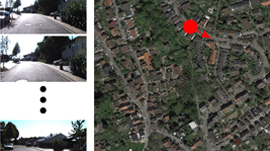
Researchers from the Toyota Technological Institute at Chicago (TTIC) and Carnegie Mellon University developed a deep learning-based method that locates a ground vehicle by using satellite imagery as the only prior knowledge of the environment.
Knowing the exact location of a vehicle is critical for autonomous cars, and currently GPS systems are being used which the researchers claim suffer from limited precision and are sensitive to multipath effects – such as in “urban canyons” formed by tall buildings.
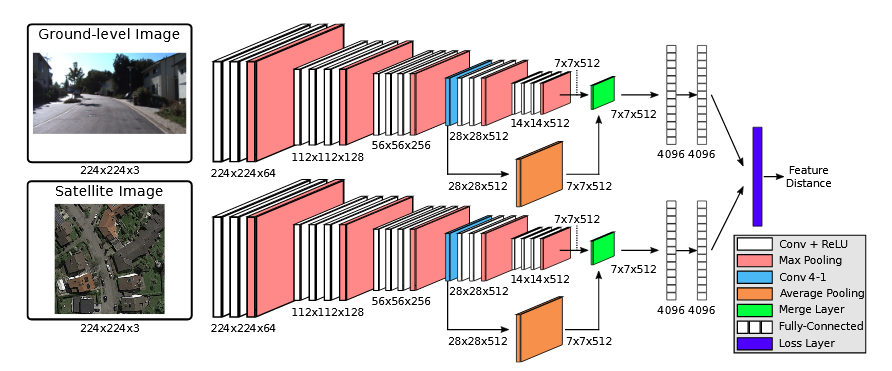
Using TITAN X GPUs, CUDA, and Keras with the Theano deep learning framework, the researchers multi-view neural network learns to match ground-level images with their corresponding satellite view. For training, they used ground-level images from the KITTI dataset collected from a moving vehicle and paired them with the matching satellite image.
The next step for the work is to adapt their model so it is able to tolerate more severe appearance variations like seasonal changes.
Read more >
AI-Generated Summary
- Researchers from the Toyota Technological Institute at Chicago and Carnegie Mellon University developed a deep learning method that locates ground vehicles using only satellite imagery as prior environmental knowledge.
- The multi-view neural network matches ground-level images with corresponding satellite views, trained on KITTI dataset ground-level images paired with matching satellite imagery.
- The network architecture uses two independent convolutional neural networks adapted from VGG-16, combining mid-level and high-level features to measure distance between ground and satellite perspectives.
- Experiments were accelerated with TITAN X GPUs, CUDA, and Keras with the Theano framework.
Next Steps
- Read the research paper for detailed methodology and results.
Powered by NVIDIA Nemotron. AI-generated content may summarize information incompletely. Verify important information. Learn more
About the Authors