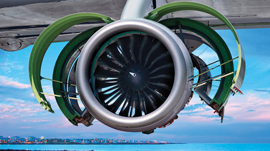
Vivek Venugopalan, a staff research scientist at the United Technologies Research Center (UTRC) shares how they are using deep learning and GPUs to understand the life of an aircraft engine and predictive maintenance for elevators in high-rise buildings.
“GPUs have helped us arrive at solutions quickly for computationally intensive challenges across all UTRC platforms, especially in this era of big data and internet of things,” said Venugopalan. “This is very critical because what used to take months to come to a solution, we are now able to achieve this in a couple of hours.”
Share your GPU-accelerated work with us at http://nvda.ws/2cpa2d4.
Watch more scientists and researchers share how accelerated computing is benefiting their work at http://nvda.ws/2dbscA7
Developer Spotlight: Applying Deep Learning to Aerospace Technologies and Integrated Systems
May 03, 2017
Discuss (0)
AI-Generated Summary
- United Technologies Research Center applies deep learning and GPUs to model aircraft engine lifecycles and enable predictive maintenance for high-rise elevators.
- Staff research scientist Vivek Venugopalan reports that GPU acceleration reduces solution time from months to hours for computationally intensive challenges across UTRC platforms.
- GPU-accelerated computing supports big data and internet of things workloads at UTRC.
Next Steps
- Share your GPU-accelerated work with NVIDIA.
- Watch more scientists and researchers share how accelerated computing benefits their work.
Powered by NVIDIA Nemotron. AI-generated content may summarize information incompletely. Verify important information. Learn more
About the Authors