To help better understand how proteins interact in the body, Purdue University researchers developed a deep learning-based approach for modeling protein interactions, a first for AI the researchers say. The work has the potential to help fight various diseases and to design better drugs that directly target protein interactions.
“Our work represents a major advancement in the field of bioinformatics,” said Xiao Wang, a graduate student and member of the research team. “This may be the first time researchers have successfully used deep learning and 3D features to quickly understand the effectiveness of certain protein models,” he added.
Using NVIDIA TITAN RTX GPUs, with CUDA and cuDNN-accelerated TensorFlow deep learning framework, the researchers developed a system called DOVE, DOcking decoy selection with Voxel-based deep neural nEtwork, which applies deep learning principles to virtual models of protein interactions.

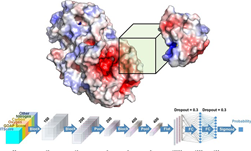
DOVE, created by Purdue researchers, captures structural and energetic features of the interface of a protein docking model with a 3D box and judges if the model is more likely to be correct or incorrect using a 3D convolutional neural network.
The model examines the protein-protein interface of a virtual protein and then uses a deep learning model to identify and capture structural features of correct and incorrect models.
“This information can be used in the creation of targeted drugs to block certain protein-protein interactions,” Wang said.
The NVIDIA TITAN RTX GPUs are used for both training and inference, the researchers said.
A paper describing the work was published this week in the journal Bioinformatics. The researchers have also published their code on GitHub, as well as an online demo to allow anyone to try the code.