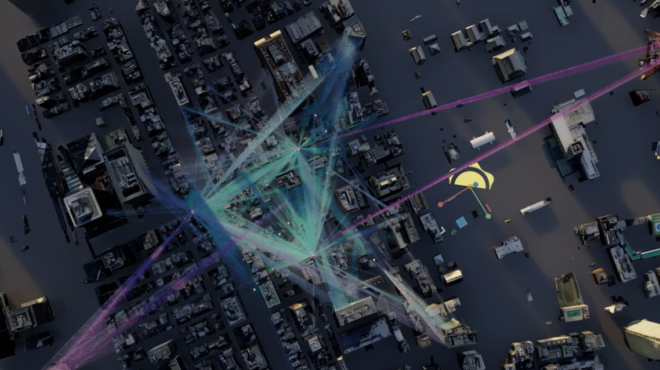
To make 6G a reality, the telecom industry must overcome a fundamental challenge: how to design, train, and validate AI-native networks that are too complex to be tested in the physical world.
The NVIDIA Aerial Omniverse Digital Twin (AODT) solves this by enabling a continuous integration/continuous development (CI/CD)-style workflow where Radio Access Network (RAN) software is trained, simulated, and validated in a physics-accurate environment before field deployment. As discussed in a recent post, this approach bridges the gap between statistical models and real-world network performance.
But the usability of any technology is as important as the technology itself. That’s why NVIDIA designed AODT not just as a powerful simulation platform, but with a modular and accessible architecture that partners and developers can easily integrate into their own workflows.
Within two years of its launch, AODT’s modular architecture is growing an ecosystem of commercial partner products, making high-fidelity simulation accessible from desktops to the cloud. This blog post spotlights five NVIDIA partners using the modular AODT platform to build commercial solutions. From RAN digital twins and cloud-scale channel simulations to high-fidelity network planning, these solutions provide a unified foundation to plan, build, and test AI-native 6G networks.
The role of AODT in accelerating network innovation
Part of the NVIDIA AI Aerial platform, AODT provides the physics-accurate simulation engine required to train and fine-tune AI models across the RAN, with unprecedented scale, fidelity, and accuracy.
Designed to be modular, AODT enables developers to integrate or customize components based on specific use cases and development needs. Developers can start with built-in NVIDIA models for rapid prototyping or plug in their own, such as proprietary propagation engines, RAN digital twins, and user equipment (UE) digital twins, to create a full-network digital twin environment.

The following are five NVIDIA partners using the modular AODT platform to build commercial solutions.
- Nokia RAN Digital Twin
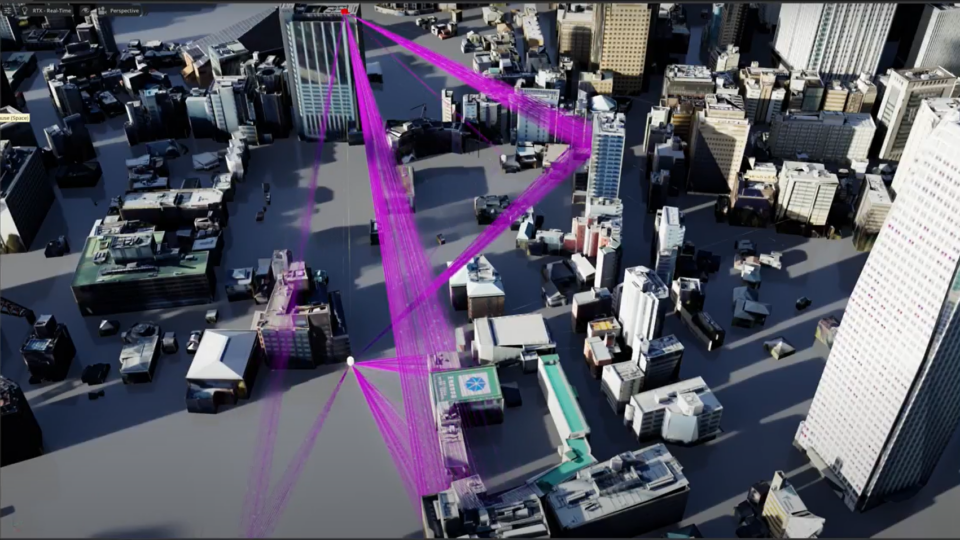
Nokia’s new RAN Digital Twin—integrated with AODT—combines Nokia’s advanced RAN algorithms with the NVIDIA physics-based simulation engine. The AODT engine uses accelerated ray tracing to model how radio waves interact with real-world materials and environments like glass, concrete, trees, or vehicles. Nokia’s Digital Twin Core analyzes network performance at the product level for base stations and user equipment. This modular approach enables operators to optimize site placement, refine beamforming strategies, and validate algorithms before hardware deployment in the physical world.

- Keysight Technologies
Keysight’s Channel Studio RaySim solution, powered by AODT, transforms traditional stochastic and semi-deterministic channel modeling into site-specific, fully deterministic channel modeling required for 6G and AI-RAN development. RaySim delivers precise, 6G-ready ray-tracing channel models at speed and scale, enabling researchers to explore new waveforms, test mobility scenarios, and evaluate complex propagation environments in photorealistic digital worlds.
Building on RaySim, Keysight’s AI‑RAN Simulation Toolset enables developers to integrate the NVIDIA AI Aerial platform to create hardware testbeds and digital twins that facilitate training and benchmarking of AI-RAN workloads in an integrated, end-to-end workflow.

- VIAVI Solutions TeraVM AI RSG
VIAVI’s TeraVM AI RAN Scenario Generator (AI RSG), fully integrated with AODT, gives developers the ability to simulate detailed, physics-grounded RAN behavior. Now available on AWS Cloud, AI RSG provides scalable, on-demand access to high-fidelity RAN testing—for teams to parallelize experiments, automate benchmarking, and accelerate AI-RAN validation cycles.
Calibration is essential for creating an accurate digital twin tailored to customer-specific networks. AODT is calibrated with field measurements from the VIAVI OneAdvisor 800 Wireless, creating highly accurate digital twin representations of customer cell sites and producing the most valuable datasets for machine learning and AI-driven RAN optimization.

- Ansys Perceive EM and Ansys HFSS
Ansys, part of Synopsys, is integrating Ansys HFSS and Ansys Perceive EM software with AODT, expanding the capabilities of these tools and enabling full network simulation for users. High-frequency electromagnetic simulation software (HFSS) provides physics-accurate antenna and array design. Perceive EM radio frequency channel radar signature simulation software extends electromagnetic fidelity to wireless channel modeling in detailed, dynamic, motion-rich environments. AODT scales those models to full network deployments. This workflow forms a continuous electromagnetic chain, from antenna to network, enabling researchers to train and validate AI-RAN and integrated sensing and communications (ISAC) systems with true physical accuracy.

- Amazon Web Services (AWS)
With AWS, AODT moves to the cloud, giving researchers and network operators on‑demand access to large‑scale, physics‑accurate network simulation. Running AODT on AWS enables teams to spin up virtual test environments that replicate city‑scale networks, experiment with new RAN topologies, and analyze performance under dynamic, real‑world conditions—all without maintaining dedicated on‑premises infrastructure.
AWS has leveraged the NVIDIA three-computer “Train → Simulate → Deploy” system to enable AI-native networks through cloud-scale intelligence. In the Train phase, Amazon Bedrock and Amazon SageMaker train domain-specific LLMs on RAN data, including R1 interface telemetry and configuration procedures, enabling models to understand and reason over RAN control signaling, resource management, and protocol-level behaviors. In the Simulate phase, NVIDIA AODT validates implementations across physics-accurate scenarios in parallel, compressing validation timelines from months to days. In the Deploy phase, Agentic applications enable agentic coverage optimization and intelligent energy savings improvements. Central to this phase is the recursive data foundation — production outputs feed back into the training loop, enabling the model to improve continuously over time.
The future of 6G starts with simulation
With NVIDIA Aerial Omniverse Digital Twin and its expanding ecosystem of partners, the telecom industry has a unified, physics-accurate foundation for creating, validating, and accelerating AI-native wireless systems.
As the industry advances toward autonomous networks, simulation becomes essential: intelligent network agents—powered by AI—need trusted virtual environments to test and validate their recommendations before acting in live networks. Digital twins bridge that gap— closing the loop between training and deployment, enabling networks to self-learn, self-heal, and self-optimize in real time.
Explore AODT partner solutions to kickstart your 6G research and development, and join the NVIDIA 6G Developer Program to collaborate with us in building the intelligent networks of the future.