‘Meet the Researcher’ is a series spotlighting researchers in academia who use NVIDIA technologies to accelerate their work.
This month’s spotlight features Peerapon Vateekul, assistant professor at the Department of Computer Engineering, Faculty of Engineering, Chulalongkorn University (CU), Thailand. Vateekul drives collaboration activities between CU and the NVIDIA AI Technology Center (NVAITC) including seminars and workshops on joint applied research in Medical AI and NLP. He has been collaborating with NVIDIA since 2016 and became a university ambassador and certified DLI instructor for NVIDIA in 2018.
What are your research areas of focus?
My research focuses on interdisciplinary data analysis, applying machine learning techniques and a deep learning approach, to various domains. This includes AI-assisted medical diagnosis, hydrometeorology, geoinformatics, NLP, and finance. Some of my recent work focuses on medical diagnoses, such as working on AI-assisted solution polyp detection in colonoscopies in real time.
For NLP, my research group recently presented on a research project that deploys software agents equipped with natural language, understanding capabilities to read scholarly publications on the web.
When did you know that you wanted to be a researcher, that you wanted to pursue this field?
I realized that I wanted to be a researcher in the machine learning domain when I pursued my master’s degree. It was even clearer to me after I returned to Thailand and joined the Department of Computer Engineering at CU. I had the chance to collaborate with many researchers and professors from various schools. It felt impactful to be able to apply machine learning techniques to solve real-world problems.
What is the impact of your work on the field/community/world?
I tackle real world problems. AI-assisted telemedicine has played an important role in the pandemic era, thus I want to develop a model that can help a doctor to diagnose patients more accurately and efficiently.
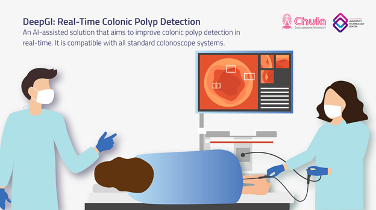
For example, our research team is now implementing a real-time polyp detection solution for colonoscopies that can be deployed in an operation room. In this work, we have overcome the real-time inference constraint by using both software and hardware solutions. Especially for the hardware, where we have used a medical computer with an NVIDIA GeForce RTX, alongside a video switcher to analyze and render the video in real-time.
How do you use NVIDIA technology in your research?
I have been using NVIDIA technology in two aspects. First, a powerful server with an NVIDIA GPU is crucial to my research. Second, I have been using NVIDIA SDK’s and pretrained models from NVIDIA NGC in research works. For example, I have collaborated with Prof. Sira Sriswasdi from the medical school at CU. We aim to improve the COVID-19 diagnosis and prognosis prediction by using multi-zone lung segmentation in chest x-ray images. We’re using the NVIDIA CLARA SDK, which is a complete solution for AI-assisted medical imaging, that also contains federated learning to train a model across multiple sites (hospitals) without sharing sensitive patient data.
What’s next for your research?
The next step in my research is to translate the research work into a product (software) that can be used in a real-world scenario. Furthermore, I plan to extend my current works in many aspects. For example, I plan to extend the solution to support other parts of the gastrointestinal tracts. Apart from the polyp detection in colonoscopy, we can train a model to segment gastric intestinal metaplasia areas in gastroscopy.
Also, we are working to extend our scientific research system, ESRA, which now supports only publications in the computer science domain, to other domains, including bioinformatics.
Any advice for new researchers, especially to those who are inspired and motivated by your work?
For me, building successful research required three main factors: suitable machine learning techniques, training data along with domain experts, and a powerful GPU server. In addition, it is important to be a part of the research community since the AI related technologies have been changing rapidly; thus, you can keep updating your knowledge by being a part of the research community.
To learn more about the work that Peerapon Vateekul and his group is doing, visit his academia webpage.