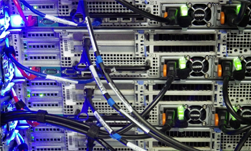
To help MIT researchers run more elaborate AI models, IBM is donating a $12 million GPU-accelerated supercomputer, powered by the latest NVIDIA V100 GPUs, to the university.
The new cluster named Satori, a Zen Buddhism term for “sudden enlightenment,” will come online this fall in conjunction with the opening of the university’s new College of Computing.
The new supercomputer is modeled after the architecture of Summit, the world’s fastest supercomputer.
Comprised of 256 NVIDIA V100 GPUs, 64 IBM Power 9 Nodes, interconnected via EFR Infiniband, Satori is expected to perform 2 quadrillion calculations per second.
“IBM’s gift couldn’t come at a better time,” said Maria Zuber, a geophysics professor and MIT’s vice president of research. “The opening of the new college will only increase demand for computing power. Satori will go a long way in helping to ease the crunch.”
The system is specifically built for AI researchers working on projects such as designing the next hearing aid to a longer-lived lithium-ion battery.
Satori will be open to all members of the MIT academic community, the university says.