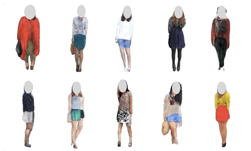
Using GANs, this deep learning-based system can act as a personal fashion designer by recommending changes that can make a person’s outfit more fashionable.
Using large portions of NVIDIA’s Pix2PixHD code, Facebook AI researchers in collaboration with UT Austin, Cornell University, and Georgia Tech developedFashion++, a deep learning-based model that uses GANs to offer suggestions on what to add, remove, swap, or adjust.
“Our model consists of a deep image generation neural network that learns to synthesize clothing conditioned on learned per-garment encodings,” the researchers stated in their paper.
At the crux of the work is an activation maximization approach that operates by using encodings from the GAN. the As a first step, Using NVIDIA P100and V100 GPUs, with the cuDNN-accelerated PyTorch deep learning framework, the researchers trained their model on thousands of publicly available images considered to be fashionable.
Once trained, the image-generating neural network identifies and generates the garments or accessories that will best resemble fashionable styles.
Given an original outfit as the input, the system first maps its composing pieces, which can include items such as a bag, blouse, boots, shirts, to their respective codes. Then, the system uses a discriminative fashionability editing model to gradually update the encodings in the direction that maximizes the outfit’s score, thereby improving its style, the researchers explained.
According to the researchers, the system will only recommend images closer to the original image or ground truth, helping human users easily implement the proposed changes.
This work shows the potential of AI as assistive technology. “Our method of bootstrapping unfashionable examples shows how AI systems can learn even without resource-intensive human annotation,” the researchers state.
A PyTorch implementation of the work is available on GitHub.