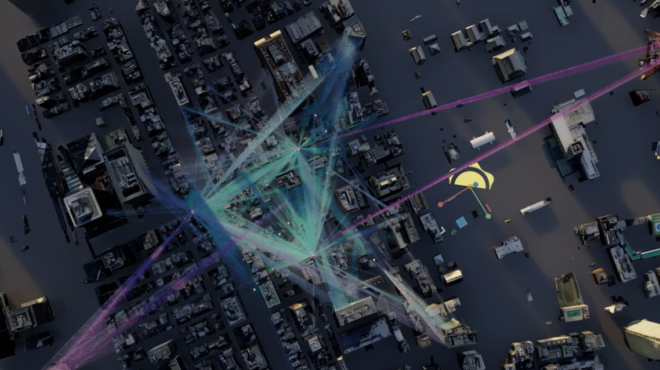
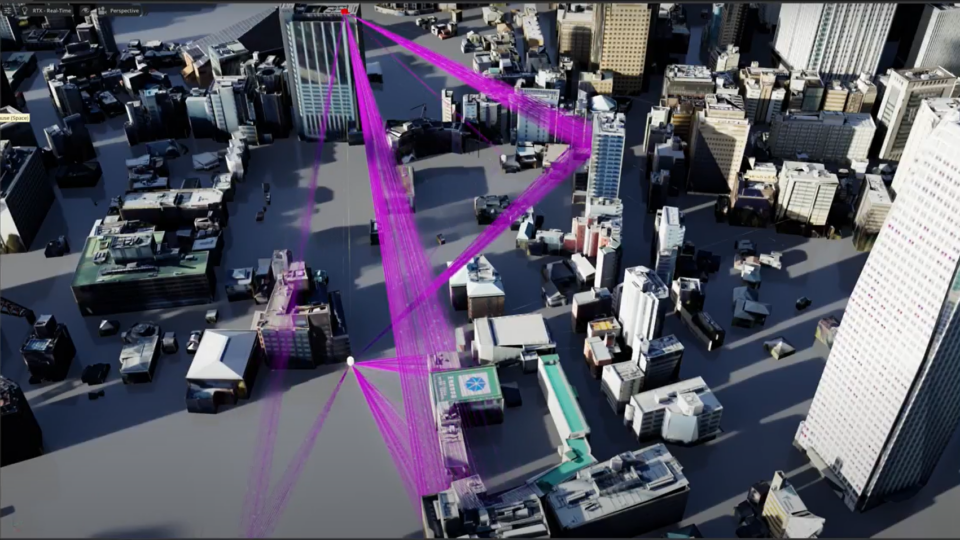
AI-native 6G networks will serve billions of intelligent devices, agents, and machines. As the industry moves into new spectrums like FR3 (7–24 GHz), radio physics becomes far more sensitive, shifting the network from a static infrastructure to a dynamic, living system.
This shift demands a fundamental change in how we design, build, and optimize 6G systems. Traditional “build and test” methods are no longer viable. We cannot afford the cost or time to test every AI algorithm in physical environments. To deliver the benefits of AI-native 6G, the industry requires a continuous integration/continuous development (CI/CD) approach to Radio Access Network (RAN) software—powered by physically accurate digital twins.
Powering the 3-Computer solution behind AI-RAN and 6G

The development cycle of 6G for software-defined AI-RAN will closely mirror the AI development cycle, relying on a well-known AI paradigm, the three-computer solution. NVIDIA supports developers across every computer, with hardware and software.
Computer 1: Design and training
This crucial phase uses the computational power of accelerated computing platforms, such as NVIDIA DGX and NVIDIA DGX Spark, to accelerate the entire design and training workflow. NVIDIA provides a comprehensive suite of specialized software tools to maximize performance:
- NVIDIA Aerial CUDA-Accelerated RAN: A high-performance, real-time, software-defined framework for rapidly simulating and deploying complex RAN systems using GPUs.
- NVIDIA Sionna: A dedicated, GPU-accelerated library for modeling and training the physical-layer of advanced communication systems.
Computer 2: The simulation bridge
The telecommunications industry is moving toward digital deployments, where new designs are first rigorously evaluated in highly accurate radio frequency (RF) environments. The NVIDIA Aerial Omniverse Digital Twin (AODT) is a bridge for accelerating this transition, moving development from simple simulators to comprehensive, real-time digital twins.
The AODT achieves this through two core abilities:
- Provision of accurate radio environments: It offers a physics-accurate representation of real-world RF conditions, ensuring performance in the digital twin is predictive of actual physical deployment.
- Real-time fabric connectivity: A low-latency data fabric connects complex AI-RAN stacks with the digital RF environments. This real-time link enables true, closed-loop system simulation.
Computer 3: Field deployment
Once a design is rigorously trained and validated in the digital twin, it is deployed directly to the NVIDIA Aerial RAN Computer (ARC)—a high-performance CUDA-accelerated platform for executing RAN functions in the field. This transition is accelerated by the NVIDIA Aerial framework, which simplifies and automates the traditionally complex process of hardening the data-plane algorithms. The framework ensures rapid and reliable deployment of advanced capabilities developed in previous environments onto GPU-accelerated hardware.
Overcoming the three barriers to digital deployment
This brings us to the core mission of AODT:
- To support the simulation of cellular systems with physics-compliant accuracy.
- To drive the virtuous cycle between simulators and digital twins, ensuring that what works in the digital world works in the real world.
To achieve fluidity between simulators and digital twins, AODT addresses three fundamental barriers that have historically held back the simulation ecosystem.
Accuracy
Simulation is futile if it doesn’t predict reality. Traditional stochastic channel models often rely on “plane wave” approximations that treat complex antenna arrays as single points. While sufficient for 5G, these approximations crumble under the physics of 6G, which relies on Extremely Large Antenna Arrays (ELAA) and near-field propagation. AODT bridges this gap by delivering a physics-compliant environment that mirrors the real world. By using deterministic, full-wave ray tracing that models individual antenna elements and spherical wavefronts, a design validated in the twin behaves predictably in the field.
Integration
Advanced RF physics is notoriously complex to implement. While most research teams and vendors maintain their own system-level simulators in Python, C++, or MATLAB, they rarely have the resources to build a high-fidelity ray tracer from scratch. AODT solves this by acting as a “physics engine” for the entire cellular ecosystem. By revealing a headless, gRPC-based architecture, AODT abstracts away the complexity of electromagnetics (EM). Keep your existing simulator for network logic, while AODT provides the ground-truth physics in the background.
Operation
Network operators can’t optimize what they can’t safely touch. There’s a natural hesitation to deploy aggressive AI algorithms on live networks due to the risk of service outages. AODT removes this risk by enabling an operational digital twin that runs in parallel to the live network. This enables operators to switch between real and twinned environments, validating every configuration change or software update in the safety of the digital world before it touches a real user.
A live operational digital twin, as shown in Figure 2, bridges this gap, where network software is tested in a digital twin before deployment.

This enables a production-grade, CUDA-accelerated vRAN software to switch between its live network and the twinned RF environment. This has significant implications:
- Test-before-deploy for zero downtime: Operators can validate critical software updates against a virtual copy of their real-world deployment before pushing it live, for zero network downtime.
- Debug real-world scenarios with repeatability: When a live cell experiences issues, operators can record the real environmental conditions and replay them within the digital twin. This enables a controlled, repeatable debugging of the production software.
- Accurate CI/CD pipeline: AODT enables an accurate CI/CD pipeline for network software, where every code change is validated against a realistic, large-scale virtual world before being deployed into the live network.
The AODT roadmap
The AODT product roadmap has two crucial focus areas: electromagnetic (EM) propagation, which aims to overcome the accuracy barrier, and the platform, which addresses the integration barrier.
Track 1: Advancing EM accuracy
This track is dedicated to advancing the realism and accuracy of the simulated RF environments by continuously refining them to mirror real-world conditions. It enables high-fidelity twins by precisely modeling complex physical obstructions that significantly affect signal quality.
| Product release | Key features and milestones | Strategic benefits |
|---|---|---|
| Foundation (Rel 1.0) | Core ray tracing with specular reflection, diffraction, and Lambertian diffusion. | Establishes an efficient and accurate baseline for fundamental RF simulation. |
| Mobility enhancements (Rel 1.1–1.3) | Advanced mobility physics including directional diffusion, custom antennas, O2I/I2O propagation, and dynamic scattering. | Enables realistic 6G mobility scenarios with georeferenced signal tracking for moving objects. |
| Refining realism (Rel 1.4–1.5) | Environmental integration of vegetation, hilly-terrain DTMs, and calibrated material properties (glass, concrete, brick). | Delivers high-fidelity digital twins by accurately modeling real-world obstructions affecting signal quality. |
| Future (Rel 1.6) | 3D radio-map generation and accelerated EM techniques. | Reduces runtime for large-scale, repeated queries, enabling real-time AI/ML training and massive coverage planning. |
Track 2: Building the platform
This track focuses on evolving AODT from a single-user application into a globally accessible, scalable, and integration-ready service. It decouples the simulation engine from individual user workloads, creating a robust, queryable service architecture that can be centrally managed, maintained, and continuously updated.
| Product release | Key features and milestones | Strategic benefits |
|---|---|---|
| Research tool (Rel 1.0) | AODT introduced as a standalone application running on a single GPU with a UI, with new concepts integrated in C++. | Provides initial power and speed for individual researchers to validate core physics models. |
| Expanding integration (Rel 1.2–1.3) | Enabled headless operation for servers and introduced a code-based Python API. | Opens AODT to the broader AI/ML and data-science ecosystem, allowing researchers to integrate code and run complex simulations. |
| Pivot to service (Rel 1.4) | Added inter-process communication (IPC) and a client/server architecture, transitioning AODT into a dedicated service. | Decouples the simulation engine from the user’s workload and establishes a centrally managed, queryable service architecture. |
| Cloud-native (Rel 1.6) | Completed transition to a cloud-native, headless-first architecture designed to scale across multiple GPUs or data centers. | Establishes AODT as an elastic, accessible data-center-level resource, reducing barriers to entry and enabling enterprise-level use cases. |
Empowering the AI-native 6G era
The transition from 5G to 6G must tackle greater complexity in wireless signal processing, characterized by massive data volumes, extreme heterogeneity, and the core mandate for AI-native networks. Traditional, siloed simulation methods are insufficient for this challenge.
The NVIDIA Aerial Omniverse Digital Twin is a high-accuracy, high-performance, and scalable platform built for this new era. By democratizing access and unifying the ecosystem around a common platform, the Aerial Omniverse Digital Twin provides the foundation for the AI-native 6G era.
AODT is available through the NVIDIA 6G Developer Program. We invite researchers, developers, and operators to integrate this powerful new service and collaborate with us in building the future of 6G.