More than one million athletes experience a concussion each year in the United States.
Researchers from a California-based startup Neural Analytics have designed a portable headset device that maps blood flow in the brain, which may make it easier to recognize concussions.
“There is growing evidence that concussions can change the blood flow in the brain,” said study author Robert Hamilton, PhD, co-founder of Neural Analytics and a member of the American Academy of Neurology. “While such changes may be detected with MRI, we believe there may be a less expensive and portable way to measure these changes with a transcranial Doppler (TCD) device.”
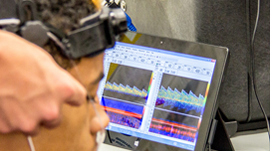
Using NVIDIA GPUs and deep learning, the device is able to distinguish the brains of young high school athletes who had recently suffered a traumatic brain injury from those of healthy subjects with 83 percent accuracy.
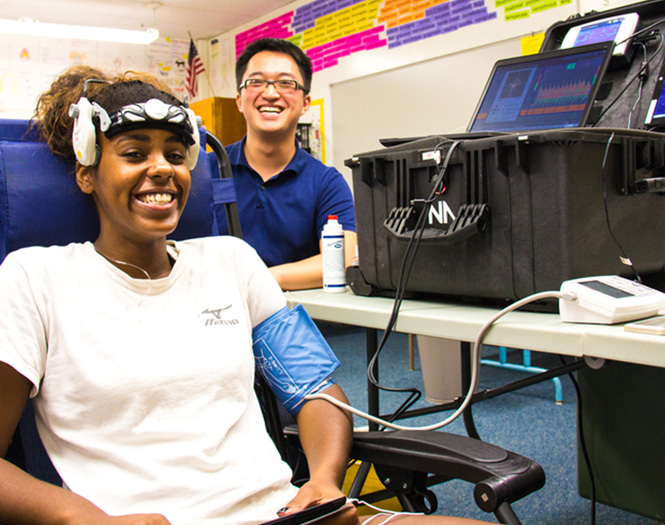
“This research suggests that this advanced form of ultrasound may provide a more accurate diagnosis of concussion,” said Hamilton. “While more research is needed, the hope is such a tool could one day be used on the sidelines to help determine more quickly whether an athlete needs further testing.”
Read more >>
Assessing Traumatic Brain Injuries with Deep Learning
Apr 25, 2016
Discuss (0)
AI-Generated Summary
- Neural Analytics researchers developed a portable headset that uses transcranial Doppler ultrasound to map cerebral blood flow for concussion detection.
- Powered by NVIDIA GPUs and deep learning, the device distinguished concussed high school athletes from healthy subjects with 83 percent accuracy.
- Study author Robert Hamilton, PhD, co-founder of Neural Analytics, indicated the technology could eventually enable rapid sideline assessment of whether an athlete needs further testing.
Next Step
- Read the ScienceDaily release for additional details on the study.
Powered by NVIDIA Nemotron. AI-generated content may summarize information incompletely. Verify important information. Learn more
About the Authors