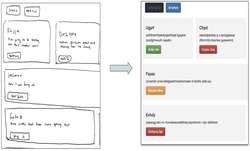
A new deep learning model allows users to create working HTML websites from hand-drawn wireframes, creating a solution for a process that normally takes weeks and involves multiple stakeholders.
The developer, Ashwin Kumar, recently participated in Insight’s Data Science Fellowship Program, which aims to bridge the gap between academia and data science. There, he developed a unique and breakthrough technology that allows anyone to build a website with just a simple sketch.
Using NVIDIA Tesla V100 GPUs on the Amazon Cloud and the cuDNN-accelerated TensorFlow deep learning framework, Kumar trained his neural network on 1,750 screenshots of synthetically generated websites and their relevant source code.
“My goal at Insight was to use modern deep learning algorithms to significantly streamline the design workflow and empower any business to quickly create and test webpages,” Kumar wrote in a Medium post.

Kumar mentions that the current design process is slow and can quickly turn into a bottleneck, preventing startups and small businesses from getting off the ground.
He concedes that his model has some limitations, but explains that by training his neural network with additional elements such as images, drop-down menus, and online forms, it will improve the algorithm.
Kumar now works as a deep learning scientist at Mythic, a startup that aims to bring AI to every connected device.
Read more >
AI-Generated Summary
- A new deep learning model converts hand-drawn wireframes into functional HTML websites, compressing a workflow that normally takes weeks.
- Developer Ashwin Kumar trained the neural network on 1,750 screenshots of synthetically generated websites and their source code using NVIDIA Tesla V100 GPUs on Amazon Cloud with the cuDNN-accelerated TensorFlow framework.
- The approach targets the bottleneck in traditional design workflows where product managers, designers, and engineers iterate through research, mockups, and code implementation.
- Kumar notes the model currently has limitations but can improve by training with additional elements such as images, drop-down menus, and online forms.
Next Steps
- Read the Insight Data Science blog post for details on the automated front-end development project.
Powered by NVIDIA Nemotron. AI-generated content may summarize information incompletely. Verify important information. Learn more
About the Authors