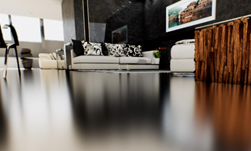
Reproducing accurate reflections has always been a big challenge in game development. Artists and engineers traditionally needed to apply a complex set of connected solutions – and even then, the results can be jarring. Edward explains how ray tracing and denoising solves this.
Five Things to Remember:
- Prior solutions such as SSR (Screen Space Reflection) suffers from the ‘missing geometry/data’ problem: when you move the camera down, things just disappear in reflections. Pre-integrated light probes are not dynamic and can be VERY wrong if placed incorrectly. Planar reflections only work for planar surfaces; this rasterization approach will not allow for glossy surfaces.
- By contrast, ray tracing with denoising does not lose geometry, is dynamic, and works on a wide range of surfaces, including glossy ones.
- Shadows denoiser results can be of lower quality for overlapping penumbra from two occluders with very different distances from the receiver.
- Reflections denoiser is further from ground truth as roughness increases.
- AO denoiser may need 2 or more rays to capture finer details.
You can find six additional coffee-break length videos about ray tracing in games with RTX on the NVIDIA developer blog.