Starter Kits by Use Case
Build Your Own Transaction Foundation Model
The Build Your Own Transaction Foundation Model developer example provides developers with a starting point to build embeddings using transformer architecture on tabular data.
Optimize Financial Signal Discovery with Multi-Agent Systems
The Quantitative Signal Discovery Agent developer example demonstrates how to automate signal discovery—a core workflow in quantitative trading—using an agentic architecture built with NVIDIA Nemotron family of open models and the NVIDIA NeMo Agent Toolkit open-source library.
Scale Real-Time Decisions With Accelerated Portfolio Optimization
Traditional CPU-based workflows for portfolio optimization are slow, limited in scale, and unable to support real-time analysis. With AI acceleration, financial firms can model advanced risk measures, process large-scale portfolios in real time, and improve operational efficiency, enabling faster, more informed investment decisions.
Detect Anomalies With Fraud Prevention
AI-enabled applications using deep learning techniques such as graph neural networks (GNNs) can reduce false positives in transaction fraud detection, enhance identity verification accuracy for know-your-customer (KYC) requirements, and make anti-money laundering (AML) efforts more effective, improving both the customer experience and your company’s financial health.
Accelerate Feature Engineering From Unstructured Data
Financial institutions consume massive volumes of unstructured data in their alpha research, feature generation, and strategy creation processes. By combining real-world financial data streams (news, filings, calls) with automated fine-tuning and evaluation, AI accelerates signal backtesting and the time from research to actionable models.
Explore Tools and Technologies for Financial Services
NVIDIA HPC SDK
Optimize High-Performance Computing for Trading
Segments: Trading
The NVIDIA HPC SDK includes the proven compilers, libraries, and software tools essential for maximizing developer productivity and the performance and portability of HPC applications.
NVIDIA NeMo
Build, Customize, and Deploy Generative AI Models
Segments: Banking, Payments, Trading
NVIDIA NeMo™ is an agent-first, open suite of libraries with skills for accelerating AI agent specialization, optimization, and governance.
NVIDIA Dynamo
Distribute and Disaggregate Generative AI Serving
Segments: Banking, Payments, Trading
NVIDIA Dynamo is an open-source, low-latency inference framework for serving generative AI models in distributed environments. It scales inference workloads across large GPU fleets with optimized resource scheduling, memory management, and data transfer, and it supports all major AI inference backends.
CUDA-X Data Science
Accelerate Data Preparation
Segments: Banking, Payments, Trading
CUDA-X™ Data Science is a collection of open-source libraries that accelerate popular data science libraries and platforms, part of the CUDA-X collection of highly optimized, domain-specific libraries built on CUDA®.
GNNs
Detect Anomalies for Fraud Prevention
Segments: Payments
Graph neural network (GNN) frameworks are easy-to-use Python packages that offer building blocks to build GNNs on top of existing deep learning frameworks. These can be used for a wide range of applications, such as enhancing accuracy for transaction fraud detection.
NVIDIA FLARE
Train Machine Learning Models with Privacy and Security
Segments: Banking, Payments
NVIDIA FLARE™ (Federated Learning Application Runtime Environment) is a domain-agnostic, open-source, and extensible SDK for federated learning.
Browse by Resource Type
Accelerating End-to-End Data Science Workflows
Learn how to build and execute end-to-end, GPU-accelerated data science workflows that let you quickly explore, iterate, and move your work into production. In this self-paced lab, you’ll learn how to use RAPIDS accelerated data science libraries to perform data analysis at scale with a wide variety of GPU-accelerated algorithms.
Generative AI Explained
Explore generative AI, which has recently taken the world by storm. Using neural networks to identify patterns and structures within existing data, it generates new content based on a variety of inputs. In this course, you’ll learn generative AI concepts, applications, and the challenges and opportunities of this exciting field.
Synthetic Data Generation for Training Computer Vision Models
Streamline synthetic data generation (SDG) using 3D assets into a single application—and modify the appearance and format of the data—with NVIDIA Omniverse Replicator. This lab highlights one of the ways deep learning tools and Omniverse can be used together to streamline deep learning workloads.

Build Your Own Transaction Foundation Model for Financial Intelligence
Learn how the Build Your Own Transaction Foundation Model developer example helps financial institutions build embeddings using transformer architecture on tabular data.

Automating and Optimizing Financial Signal Discovery with Multi-Agent Systems
Learn how the Quantitative Signal Discovery Agent developer example allows firms to automate signal discovery—a core workflow in quantitative trading—using agentic AI.
.jpg)
Accelerating Real-Time Financial Decisions with Quantitative Portfolio Optimization
Learn how the Quantitative Portfolio Optimization developer example accelerates strategy testing and time to decision in financial services.

Build Efficient Financial Data Workflows With AI Model Distillation
Learn how the AI Model Distillation for Financial Data developer example enables feature engineering and faster backtesting for research in capital markets.
Accelerate Financial Services With Enterprise AI
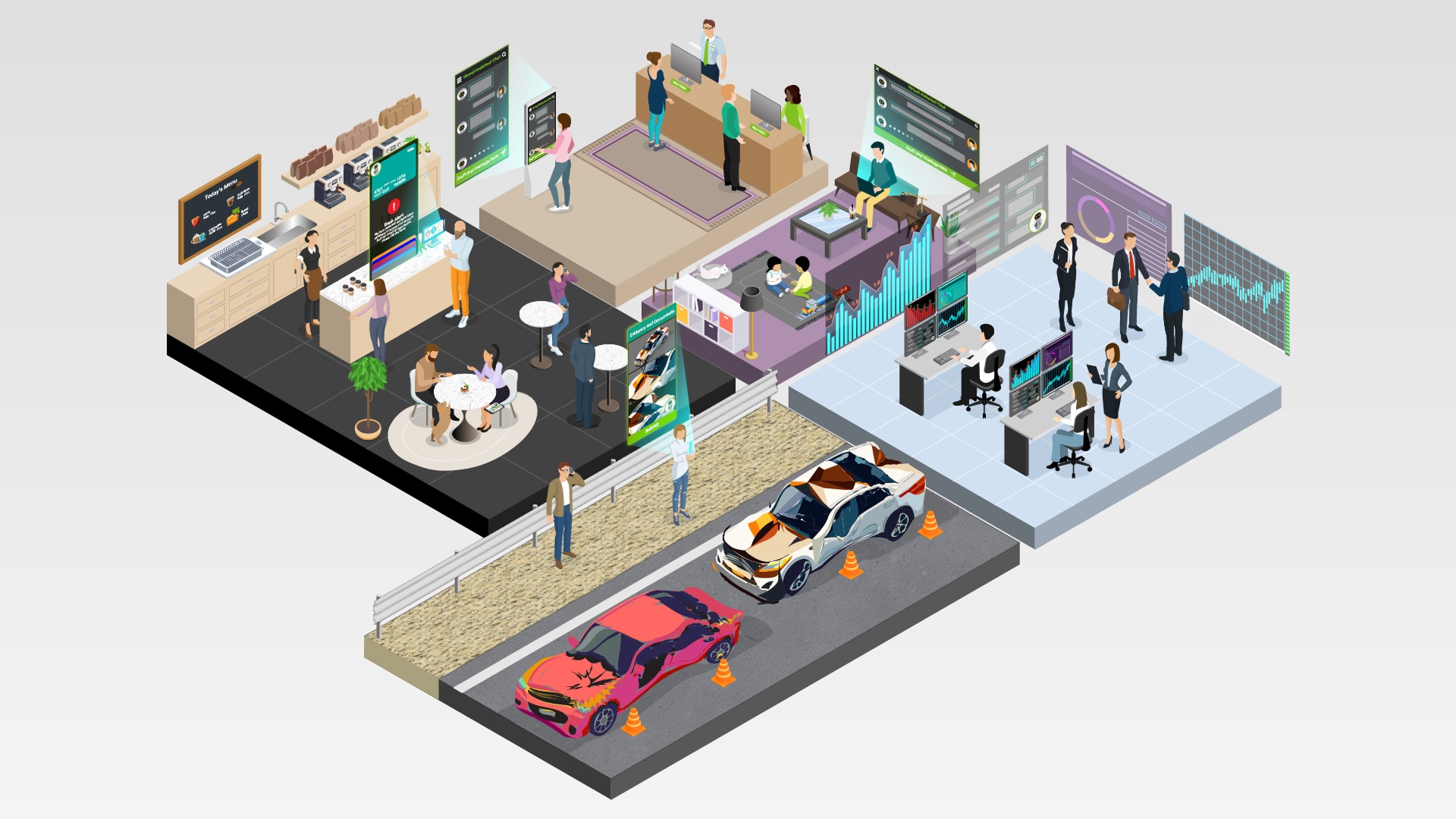
Massive datasets. Perpetual market fluctuations. Customer inquiries. Intelligent technology can address critical challenges within the modern financial services industry. With NVIDIA’s AI solutions—for generative AI, LLMs, data analytics, and more—institutions can optimize trading, detect transaction fraud, and enhance customer experiences.