
Developers Philipp Schmitt and Steffen Weiss recently unveiled a new system that uses a generative adversarial network (GAN) to generate classic 20th-century chair designs.
“Many famous designers have designed chairs, and one could argue that there have been enough chair designs in the world for quite a while. Yet, designers still design chairs. They are an expression of a person, a philosophy or state of mind, a time and place in history–like a painting,” Steffen Schmitt said. “The chair as an archetype of a designed object was a good subject for a case study,” he added.

Using NVIDIA GeForce GTX 1080 TI GPUs and a modified version of the cuDNN-accelerated PyTorch deep learning framework, Schmitt and Weiss trained their neural network on 562 images of chair designs they extracted from Pinterest.

They tasked one of the two generative adversarial networks to look at the Pinterest images and to generate similar ones. The other neural network was tasked with performing quality control and fix the designs.
The system generated hundreds of forms that are more abstract. “It was not our goal to generate a functional chair, but to generate an engaging ‘visual prompt’ for a human designer,” the developers said.
The duo called the work “The chAIr Project.”
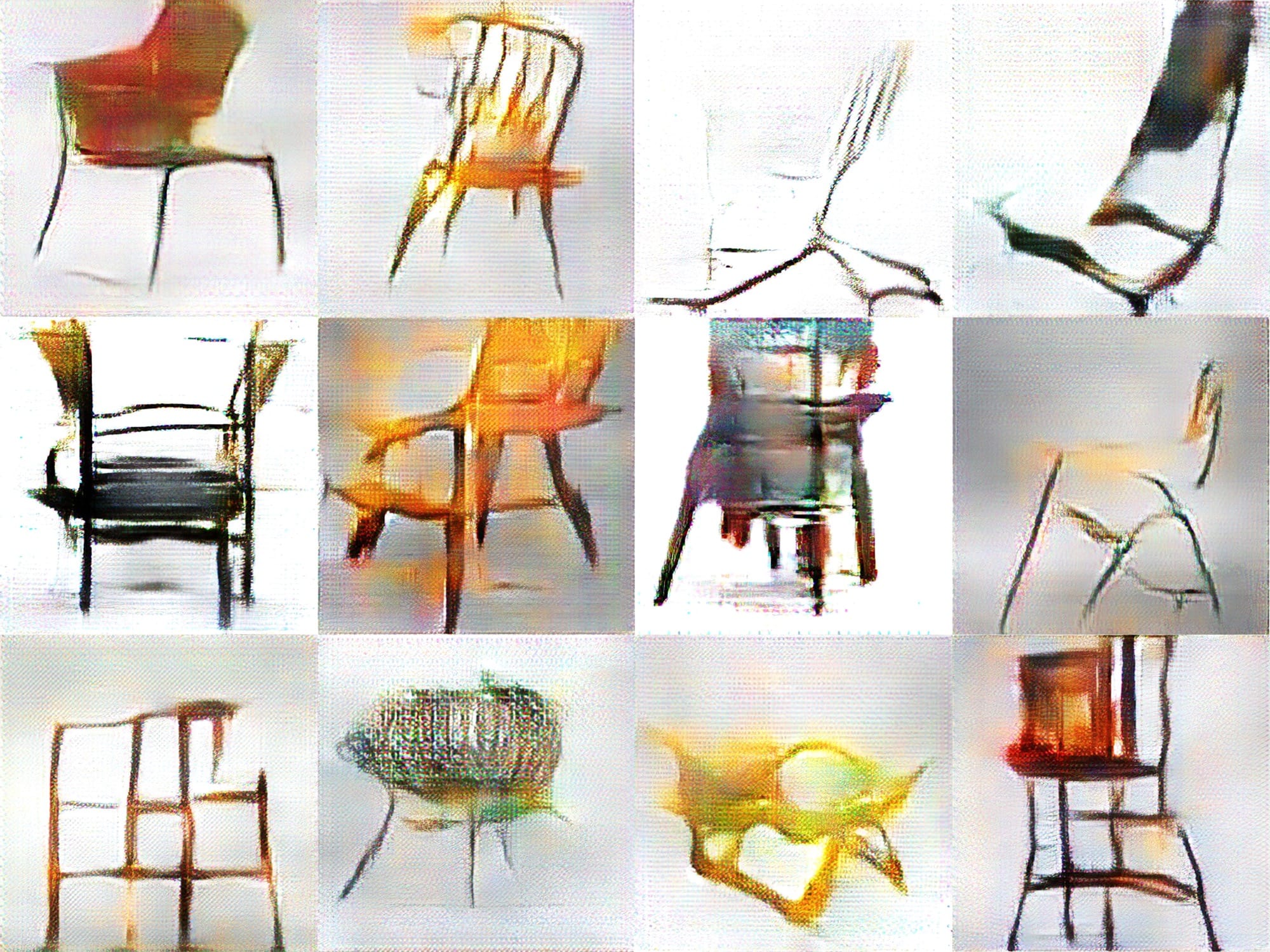
The designers took the AI-generated sketches and turned them into miniature real-life prototypes. Eventually, the team says they plan to build real-life chairs from the designs and have enlisted a Danish woodworker to create the full-scale prototypes.
“In my opinion, chair designs will remain expressions of human ingenuity, but some of the iconic designs of our current century might very well be designed with, or even entirely by, machines.”
Read more>
AI-Generated Summary
- Developers Philipp Schmitt and Steffen Weiss created the chAIr Project, a system that uses a generative adversarial network to produce abstract 20th-century chair designs.
- The team trained their neural network on 562 Pinterest images using NVIDIA GeForce GTX 1080 TI GPUs and a cuDNN-accelerated PyTorch deep learning framework.
- One GAN generated chair forms while a second network performed quality control, resulting in hundreds of abstract visual prompts for human designers rather than functional furniture.
- The designers fabricated miniature prototypes from the AI-generated sketches and plan to build full-scale chairs with a Danish woodworker.
Next Steps
- Read the chAIr Project to explore the complete case study.
Powered by NVIDIA Nemotron. AI-generated content may summarize information incompletely. Verify important information. Learn more
About the Authors