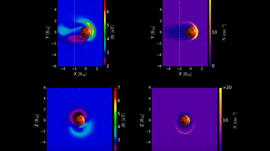
Shahab Fatemi, PhD Fellow at the University of California Berkeley Space Sciences Laboratory, shares how his team is using CUDA, TITAN X and Tesla K80 GPUs to develop a three-dimensional plasma model that can provide a better understanding of how solar wind could affect Earth.
“GPUs have been revolutionary in space and plasma physics modeling,” said Fatemi. “You can today, tackle the problems that seemed to be computationally too expensive to be solved two to three years ago.”
Fatemi and his colleagues are also using the GPU-accelerated model to explore the interior electrical conductivity of the moon, which he says can better identify the moon’s composition and determine if it is indeed similar to Earth.
Share your GPU-accelerated science with us at http://nvda.ws/2cpa2d4 and with the world on #ShareYourScience.
Watch more scientists and researchers share how accelerated computing is benefiting their work at http://nvda.ly/X7WpH
Share Your Science: GPUs Help Provide Insight on the Secrets of Solar Wind
Oct 19, 2016
Discuss (0)
AI-Generated Summary
- Shahab Fatemi and his team at the University of California Berkeley Space Sciences Laboratory are developing a three-dimensional plasma model to better understand how solar wind could affect Earth.
- The researchers use CUDA, TITAN X and Tesla K80 GPUs to accelerate the computationally intensive simulations.
- They are also applying the GPU-accelerated model to explore the interior electrical conductivity of the moon to better identify its composition and determine if it is similar to Earth.
Next Steps
- Share your GPU-accelerated science at http://nvda.ws/2cpa2d4 and with the world on #ShareYourScience.
- Watch more scientists and researchers share how accelerated computing is benefiting their work at http://nvda.ly/X7WpH
Powered by NVIDIA Nemotron. AI-generated content may summarize information incompletely. Verify important information. Learn more
About the Authors