Combine the Concorde airplane’s swooping lines, the Sydney Opera House’s soaring spaces and the intricacies of a bird’s nest, and you’ll begin to describe the transformative work of architect Daghan Cam. The teaching fellow at University College London’s Bartlett School of Architecture is using GPU computing to render stunning, abstract 3D-printed designs and train image-processing robots to construct complex structures.
Cam has been developing with CUDA for years and his latest project explores the capabilities of large-scale 3D printing combined with deep learning for robotic fabrication – all while using a Quadro K6000 graphics card and Tesla K40 GPU.
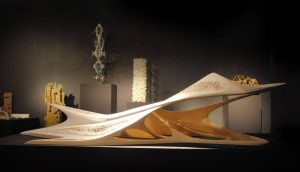
He and his team are exploring computer vision and deep learning algorithms for real-time image processing and feedback during robotic fabrication processes. This new stage of the project aims to develop advanced robotic construction techniques to build complex structures efficiently. They’ll take advantage of autonomous, decision-making robotic behavior by training industrial manufacturing robots using the NVIDIA cuDNN deep neural networks library. NVIDIA GPUs will process the image data collected by sensors on the robots.
Read more about the project on the NVIDIA corporate blog >>