Recently, at GTC21, the NVIDIA CloudXR team ran a Connect with Experts session about the CloudXR SDK. We shared how CloudXR can deliver limitless virtual and augmented reality over networks (including 5G) to low cost, low-powered headsets and devices, all while maintaining the high-quality experience traditionally reserved for high-end headsets that are plugged into high-performance computers.
Q&A session
At the end of this session, we hosted a Q&A with our panel of professional visualization solution architects and received a large number of questions from our audience. VR and AR director David Weinstein and senior manager Greg Jones from the NVIDIA CloudXR team provided answers to the top questions:
How do I get started with CloudXR?
Apply for CloudXR through the NVIDIA DevZone. If you have any questions about your application status, contact cloudxr-outreach@nvidia.com.
What did you announce at GTC?
There were three key CloudXR announcements at GTC. You can get more information about each by clicking the post links.
- NVIDIA Delivers High-Quality XR Streaming on Microsoft Azure
- NVIDIA CloudXR 2.1 Delivers Support for iOS
- NVIDIA CloudXR Now Available on AWS Marketplace
How are you addressing instances of running XR with large crowds such as convention centers or large public places?
The number of users at a single physical location is gated by the wireless spectrum capacity at that given location.
Do you need separate apps on both the client and the server?
The CloudXR SDK provides sample CloudXR clients (including source code) for a variety of client devices. The server side of CloudXR gets installed as a SteamVR plug-in and can stream all OpenVR applications.
Can I use CloudXR if I do not have high-end hardware?
CloudXR will run with a variety of hardware. For the server side, all VR-Ready GPUs from the Pascal and later architectures are supported. For the client side, CloudXR has been tested with HTC Vive, HTC Vive Pro, HTC Focus Plus, Oculus Quest, Oculus Quest 2, Valve Index, and HoloLens2.
Can the server be shared for multiple simultaneous clients or is this one server per one client only?
Currently, we only support one server per one client device. In a virtualized environment this means one virtual machine per one client.
Is connectivity (server to network to client) bidirectional?
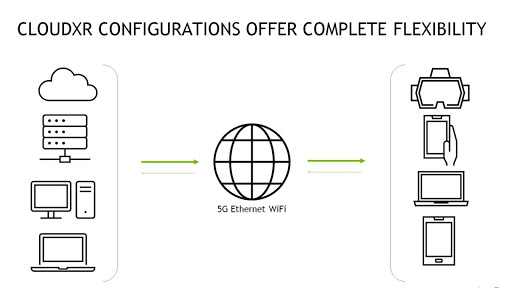
Yes, the connectivity is bidirectional. The pose information and controller input data is streamed from the client to the server; frames, audio and haptics are streamed from the server to the client.
What type of applications run with NVIDIA CloudXR?
OpenVR applications run with CloudXR.
More information
To learn more, visit the CloudXR page where there are plenty of videos, blog posts, webinars, and more to help you get started. Did you miss GTC21? The AR/VR sessions are available for free through NVIDIA On-Demand.