Cross-platform software development poses a number of challenges to your application’s build process. How do you target multiple platforms without maintaining multiple platform-specific build scripts, projects, or makefiles? What if you need to build CUDA code as part of the process?
CMake is an open-source, cross-platform family of tools designed to build, test and package software across different platforms. Many developers use CMake to control their software compilation process using simple platform- and compiler-independent configuration files. CMake generates native makefiles and workspaces that can be used in the compiler environment of your choice. The suite of CMake tools were created by Kitware in response to the need for a powerful, cross-platform build environment for open-source projects such as ITK and VTK.
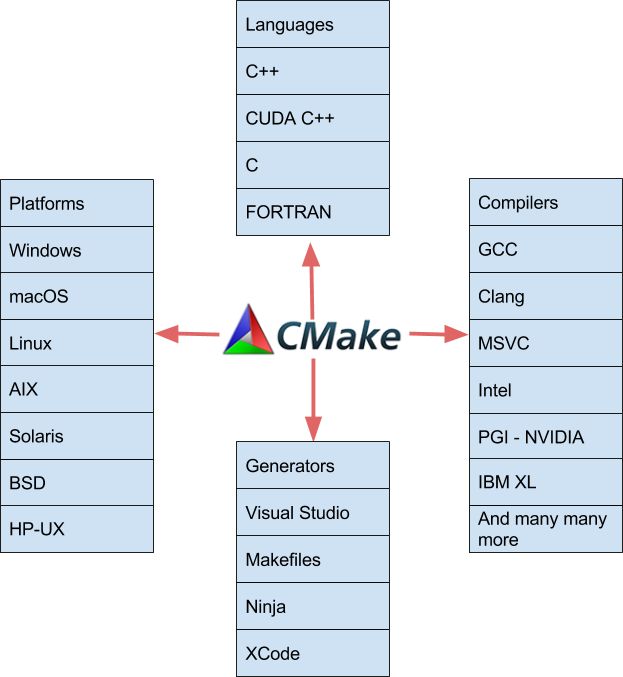
A new NVIDIA Developer blog post shows how easy it is to build CUDA applications using the features of CMake 3.8+. Since 2009, CMake (starting with 2.8.0) has provided the ability to compile CUDA code through custom commands, but CMake 3.8 makes CUDA C++ an intrinsically supported language. CUDA now joins the wide range of languages, platforms, compilers, and IDEs that CMake supports, as the Figure shows above.
Read more >
Building Cross-Platform CUDA Applications with CMake

Aug 01, 2017
Discuss (0)
AI-Generated Summary
- CMake 3.8 introduces native CUDA C++ language support, replacing the custom commands required since version 2.8.0.
- The cross-platform build system generates native makefiles and workspaces for multiple compilers and IDEs from a single configuration.
- Kitware originally created the CMake tool suite to meet the build needs of open-source projects such as ITK and VTK.
Next Step
- Read the building CUDA applications with CMake post for detailed implementation guidance.
Powered by NVIDIA Nemotron. AI-generated content may summarize information incompletely. Verify important information. Learn more
About the Authors