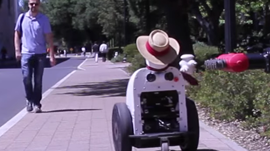
Stanford researchers in the Computational Vision and Geometry Lab developed a robot that could soon autonomously move among us with normal human social etiquettes — such as deciding rights of way on the sidewalk.
Using a Tesla K40 GPU and CUDA to train the machine learning models, the robot is able to understand its surroundings and navigate through streets and hallways with humans, and, over time, learns the unwritten conventions of social behaviors.
“By learning social conventions, the robot can be part of ecosystems where humans and robots coexist,” said Silvio Savarese, an assistant professor of computer science and director of the Stanford Computational Vision and Geometry Lab.
The researchers estimate these types of robots will become available for only $500 in five to six years.
“It’s possible to make these robots affordable for on-campus delivery, or for aiding impaired people to navigate in a public space like a train station or for guiding people to find their way through an airport,” Savarese said.
Read more >
Stanford’s Social Robot ‘Jackrabbot’ Seeks to Understand Pedestrian Behavior
Jun 03, 2016
Discuss (0)
AI-Generated Summary
- Stanford researchers in the Computational Vision and Geometry Lab developed a robot that autonomously navigates among humans using social etiquette such as deciding rights of way on sidewalks.
- The robot uses a Tesla K40 GPU and CUDA to train machine learning models that understand surroundings and learn unwritten social conventions over time.
- Researchers estimate these robots will become available for $500 in five to six years for applications like on-campus delivery and assisting impaired people in public spaces.
Next Step
- Read the Stanford news article for more details on the social robot project.
Powered by NVIDIA Nemotron. AI-generated content may summarize information incompletely. Verify important information. Learn more
About the Authors