
Simulation / Modeling / Design

Exploring Explosive Star Scenarios with 3D Simulations

AI-Generated Summary

  • Stony Brook University researchers are exploring the physics of Type Ia supernovas using the Tesla-accelerated Titan Supercomputer at Oak Ridge National Laboratory.
  • The team simulated 18 different double-detonation models using the MAESTRO subsonic hydrodynamics code to calculate a network of three elements – helium, carbon and oxygen.
  • GPU acceleration is expected to allow the team to increase the network size to around 10 elements, and early work with OpenACC directives supported in the latest PGI Compiler indicated a speedup of around 400 percent was attainable for this part of the code.
  • Team lead Michael Zingale noted that the GPU effort also benefits investigation of other astrophysical phenomena, such as x-ray bursts where the reaction network currently includes 11 nuclei with a goal of reaching 40.

Next Step

Powered by NVIDIA Nemotron. AI-generated content may summarize information incompletely. Verify important information. Learn more

Stony Brook University researchers are exploring the physics of Type Ia supernovas using the Tesla-accelerated Titan Supercomputer at Oak Ridge National Laboratory.

Exploring Explosive Start Scenariors
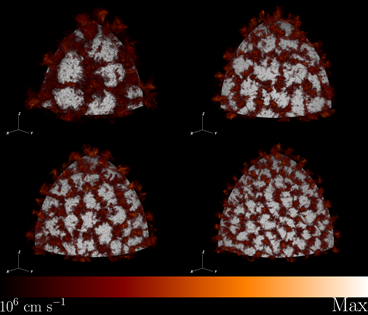
“Outflows” (red), regions where plumes of hot gas escape the intense nuclear burning at a star’s surface, form at the onset of convection in the helium shell of some white dwarf stars. This visualization depicts early convection on the surface of white dwarf stars of different masses. (Image credit: Adam Jacobs, Stony Brook University)

It’s been estimated that Type Ia supernovas can be used to calculate distances to within 10 percent accuracy, good enough to help scientists determine that the expansion of the universe is accelerating, a discovery that garnered the Nobel Prize in 2011. But despite their reputation for uniformity, exploding white dwarfs contain subtle differences that scientists are working to explain using supercomputers.

The team simulated 18 different double-detonation models using the MAESTRO subsonic hydrodynamics code to calculate a networks of three elements – helium, carbon and oxygen. They expect that GPU acceleration will allow them to increase the network size to around 10 elements, and their early work with the OpenACC directives supported in the latest PGI Compiler indicated a speedup of around 400 percent was attainable for this part of the code.
The GPU effort benefits the team’s investigation of not only Type Ia supernovas but also other astrophysical phenomena.
“Right now, our reaction network for x-ray bursts includes 11 nuclei. We want to go up to 40. That requires about a factor of 16 more computational power that only the GPUs can give us,” said the team lead Michael Zingale.
Read more about the research >>

 

Discuss (0)

Tags