Project MONAI is releasing MONAI v0.7, MONAI Label v0.2, MONAI Deploy v0.1, and announcing the MONAI Stream working group.
The MONAI Deploy working group is excited to release the MONAI Deploy Application SDK v0.1, which helps bridge the gap from innovative research to clinical production.
While MONAI Core focuses on training and creating models, MONAI Deploy focuses on defining the journey from research innovation to clinical production environments in hospitals.
There is an opportunity to create a set of intermediate steps where researchers and physicians can build confidence in the techniques and approaches used with AI. Deploying and connecting medical devices and systems in a controlled environment, users can iterate until the AI inference infrastructure is ready to move to clinical settings, with high certainty the transition will go smoothly.
MONAI Deploy App SDK v0.1
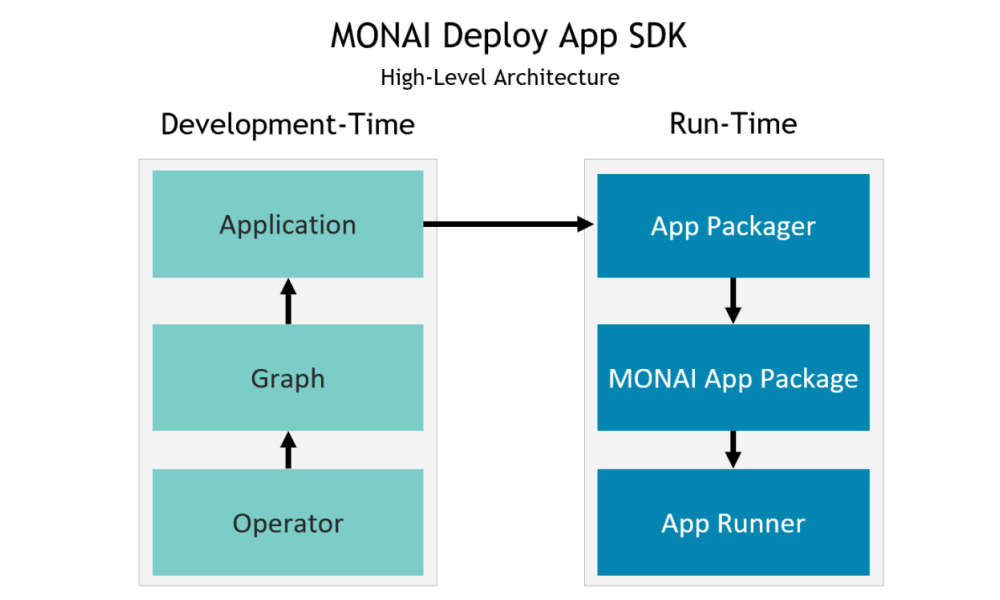
MONAI Deploy App SDK offers a framework and associated tools to design, develop, and verify AI-driven applications in the healthcare imaging domain. The key features include:
- Flexible, extensible, and usable Pythonic APIs to build healthcare imaging inference applications.
- Easy management of inference applications using programmable Directed Acyclic Graphs.
- Out-of-the-box support for in-proc PyTorch based inference.
- Seamless integration with MONAI-based pre- and post-transformations in the inference application.
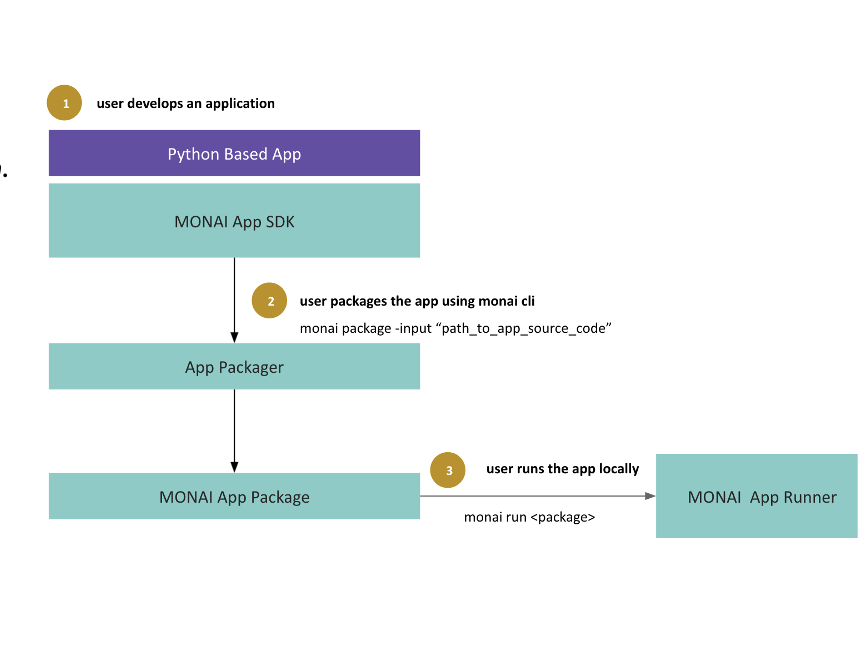
- Locally run and debug your inference application using App Runner.
MONAI Core v0.7
MONAI Core 0.7 focuses on cutting-edge performance and profiling capabilities in medical imaging AI research.
This release includes:
- Several well-documented reference implementations in Jupyter notebooks.
- A developer guide for creating high-performance training pipelines.
- Added support for NVTX Profiling Tool.
- New network models, such as Transchex and TransUNET.
MONAI Label v0.2
MONAI Label version 0.2 enables the AI-assisted annotation of medical image data from remote DICOMweb-enabled PACS systems using both 3D Slicer and OHIF.
In MONAI Label 0.2, we also introduce:
- Two new active learning strategies—TTA and Dropout.
- Integration with the OHIF Viewer.
- Support for SimpleCRF Scribbles Annotation.
Sneak Preview of MONAI Stream
MONAI is announcing the MONAI Stream Working Group, headed by Dr. Tom Vercauteren from King’s College London. This group will support the design, development, and application of MONAI Stream, which enables faster research prototyping for real-time imaging and computer-assisted interventions.
The MONAI Stream Working Group is looking for your feedback to better understand your requirements, pain points, and research ideas.
Our focus remains on enhancing the open-source core of MONAI based on feedback from every corner of academia and industry.
These three releases from Project MONAI are the beginnings of a foundation for a complete end-to-end workflow using labeling, training, and deploying for AI Medical Models. As we develop these frameworks, we encourage you to reach out to the members of these working groups with your ideas and feedback.
View the complete list of working groups >>
Let’s build MONAI together!