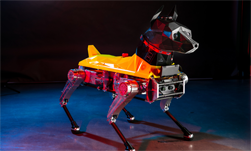
This robot not only looks like a dog but he learns like one too! Researchers from Florida Atlantic University’s Machine Perception and Cognitive Robotics Laboratory have just developed Astro the robot dog.
“Astro doesn’t operate based on preprogrammed code. Instead, Astro is being trained using inputs to a deep neural network – a computerized simulation of a brain – so that he can learn from experience to perform human-like tasks, or on his case, “doggie-like” tasks, that benefits humanity,” the researchers wrote in their project page.
Astro’s main duties will be to help the visually impaired as a service dog or to assist medical professionals with medical diagnostic monitoring.
Astro is equipped with sensors, radar, cameras, a directional microphone and a set of NVIDIA TX2 Modules to process the sensory inputs. With the onboard GPUs, Astro is capable of performing up to four trillion computations a second.
“Astro will be outfitted with more than a dozen sensors that will consume environmental input across multiple modalities including optical, sound, gas and even radar,” the researchers explained.
On the deep learning training side, Astro was trained using 4 NVIDIA GeForce RTX 2080Ti GPUs, with PyTorch for training the action classification models, and TensorFlow with TensorRT for model compression. Training data included images, video, and other data of humans in action, gestures, pose extraction and behavioral classification.
Weighing in at 60-pounds, Astro currently responds to commands such as “sit,” “stand,” and “lie down.”
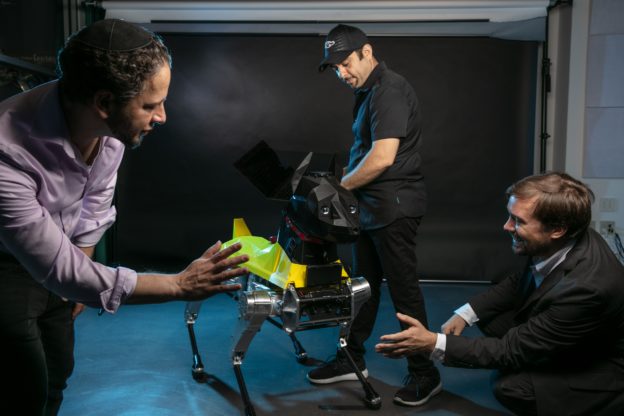
The researchers hope that Astro will eventually understand and respond to hand signals, detect different colors, comprehend multiple languages, coordinate his efforts with drones, perform facial recognition, as well as pet detection and recognition.
The researchers behind Astro include neuroscientists, IT experts, biologists, psychologists, high school students, and undergraduate and graduate students at FAU. Leading the project is Elan Barenholtz, Ph.D., an associate professor in FAU’s Department of Psychology.