NVIDIA Isaac GR00T
Generalist Robot 00 Technology
NVIDIA Isaac™ GR00T is an open reference platform for general-purpose humanoid robots that enables developers to more efficiently build, train, test, and deploy AI-powered robots.
It comprises open data and data pipelines, an open robot foundation model, simulation frameworks, middleware, CUDA-X accelerated runtime libraries, and NVIDIA Jetson Thor for real-time robot inference and control.
See Isaac GR00T in Action
How Isaac GR00T Works
Isaac GR00T includes open data and data pipelines, an open robot foundation model, simulation frameworks built on NVIDIA Omniverse™ and Cosmos™, middleware, NVIDIA® CUDA-X™ accelerated runtime libraries, and NVIDIA Jetson Thor™ for real-time robot inference and control.
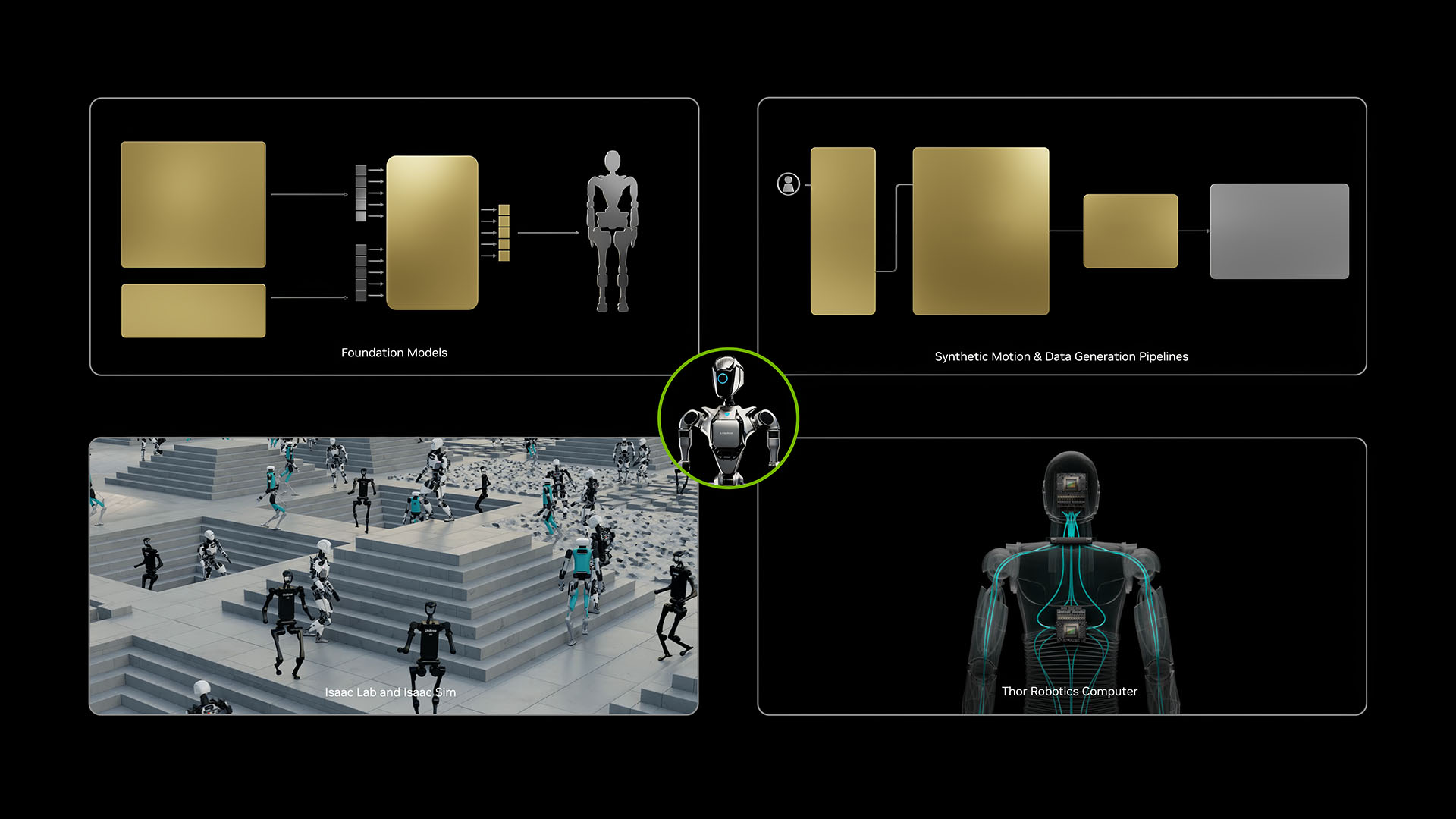
Introductory Video
Watch how Isaac GR00T helps provide the building blocks for the future of AI-powered robotics.
Introductory Blog
Explore the world’s first open foundation model for generalized humanoid robot reasoning and skills.
Learning Course
Explore our reference workflow that packages supported models, libraries, frameworks, and a task into a single reproducible workflow for a humanoid robot.
Isaac GR00T Robot Foundation Models
Isaac GR00T open foundation models are ideal for generalized humanoid robot reasoning and skills. This cross-embodiment solution takes multimodal input, including language and images, to perform manipulation tasks in diverse environments.
These models are trained on an expansive humanoid dataset consisting of real captured data, synthetic data, and internet-scale video data. They’re also adaptable through post-training for specific embodiments, tasks, and environments.
Isaac GR00T models can easily generalize across common tasks—such as grasping, moving objects with one or both arms, and transferring items from one arm to another—or perform multi-step tasks that require long context and combinations of general skills. These capabilities can be applied across a variety of use cases, including material handling, packaging, and inspection.

Isaac GR00T 1.7
Download From Hugging FaceIsaac GR00T Workflows
Discover powerful tools for accelerating the development of advanced capabilities for humanoid robots and bridge the simulation-to-reality gap.

Isaac-Teleop
Collect high-quality human demonstrations through teleoperation in the real world and simulation.

GR00T-WholeBodyControl
Achieve responsive and precise humanoid robot control with a suite of whole- body control libraries, models, and policies.
Get Started Developing Humanoid Robots
Get the software and infrastructure you need to advance your humanoid robot development with Isaac GR00T foundational technologies.
Train Robot Policies
Discover how NVIDIA Isaac Lab enables scalable, adaptable policy training in physically accurate scenes, bridging the sim-to-real gap.
Simulate and Validate
Validate the trained robot policies in physically accurate environments using NVIDIA Isaac Sim™ before deployment.
Compute Infrastructure
Train
The NVIDIA DGX™ Cloud end-to-end AI platform for training robotics foundation models gives you scalable capacity built on the latest NVIDIA architecture. It’s co-engineered with the world’s leading cloud service providers.
Simulate
NVIDIA Omniverse and Cosmos systems deliver the simulation platforms on industry-leading NVIDIA RTX™ PRO 6000 Blackwell Workstation and Server GPUs. This lets you accelerate the next generation of robotics simulation and learning workloads.
Deploy
Accelerate the development of advanced humanoid robots and run multimodal AI models. Jetson AGX Thor is based on NVIDIA Blackwell architecture and comes with integrated functional safety, high-performance CPU, and 100 GB of ethernet bandwidth.
Humanoid Developer Learning Library
Humanoid Robotics Ecosystem
NVIDIA builds foundation models, acceleration libraries, and blueprints to accelerate the world’s ecosystem of humanoid developers.








More Resources


FAQs
GR00T models accept three multimodal inputs: (1) a video sequence from onboard cameras, (2) a natural language command, and (3) the robot’s current proprioceptive state (joint positions).
The model outputs action chunks—predictive sequences of relative joint motions. By predicting multiple steps into the future, the model ensures smooth whole-body control, enabling stable locomotion and coordinated bimanual manipulation.
GR00T
models utilize a massive mixture of data sources: internet-scale human
video for world knowledge, real-world teleoperation for physical
grounding, and synthetic data generated to scale learning safely.
This
diversity enables strong generalization across different hardware. For
example, the GR00T N1.6 training set expands embodiment coverage to
include the Unitree G1, AgiBot Genie-1, and Fourier GR-1, alongside
specialized bimanual manipulation datasets (YAM).
GR00T models can be adapted to new hardware by fine-tuning them with a small collection of recorded task demonstrations. This efficient process allows the system to learn specific robot movements while preserving the broad general capabilities established during pre-training.
Isaac GR00T 1.7 Early Access allows developers to begin experimenting with the model and integrating it into their workflows ahead of the full commercial release. Developers can download the model, explore the codebase, and start building prototypes or conducting research using the NVIDIA Isaac GR00T stack.
What is supported in Early Access
Access to the pre-trained GR00T 1.7 model weights and reference code.
The ability to fine-tune or run inference with the model using custom robot data or demonstrations.
Experimentation, prototyping, and research use cases.
What is not supported
Production deployment with commercial support.
A stable feature set with thoroughly validated performance.
Product-level support from NVIDIA
Isaac Lab provides an open, modular framework to train robot policies using reinforcement learning and imitation learning. Isaac Lab is natively integrated with Isaac Sim for high-fidelity physics and rendering, Newton for an extensible physics engine, and can also use Isaac GR00T N open models and blueprints to accelerate skill learning across different robot embodiments.