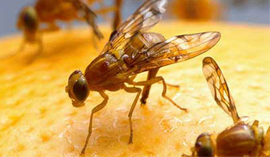
Researchers at the University of Sheffield (UK) and Columbia University (USA) have launched a GPU-accelerated project to simulate a complete model of the adult fruit fly brain for the first time. The project aims to develop a better understanding of Alzheimer’s disease and new drug targets.
The team is developing an open software platform to enable researchers worldwide to contribute data, models, and tools to construct a comprehensive model of the fruit fly (Drosophila) brain. By working collaboratively, the model can be built far more rapidly and efficiently than would be possible by teams working independently.
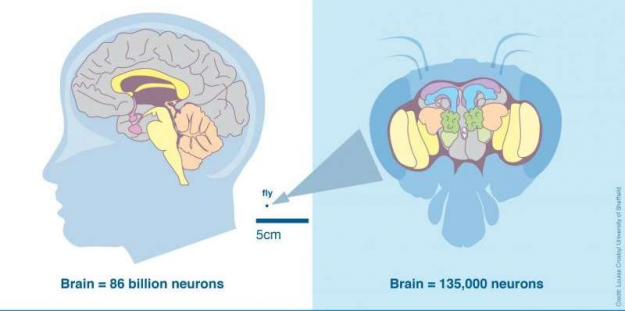
Because the fruit fly brain has just 135,000 neurons, compared to around 86 billion in the human brain, it poses a far less formidable computational challenge. The scientists believe that a ‘first draft’ model of the brain, which will incorporate existing models of the neural circuits and synaptic connections maps, could be built and simulated in the coming decade.
In order to simulate such a complex system, the software will harness the computational power afforded by the massively parallel computational capability of GPUs.
“Modelling of neural systems at the individual neuron level creates an enormous computational challenge. Utilizing power efficient and highly parallel GPUs will enable us to scale simulations to biologically credible sizes, giving real insight into emergent biological processes,” says Dr. Paul Richmond, Vice-Chancellor Research Fellow at the University of Sheffield and Co-Investigator on the project.
The Neurokernel software developed by Aurel A. Lazar’s team at Columbia University is open source and available at https://neurokernel.github.io.