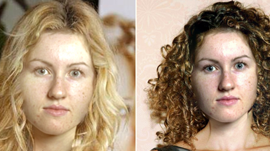
A new personalized search engine helps you explore what you would look like with brown hair, curly hair or in a different time period.
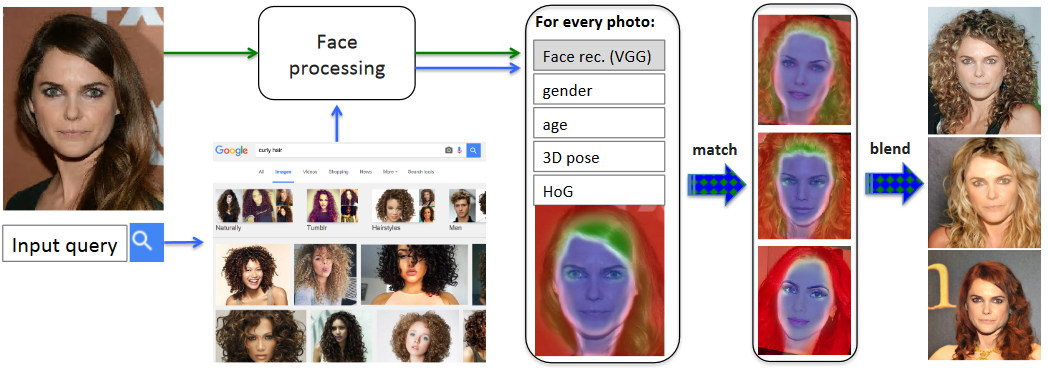
Upload a selfie to Dreambit and type in a term like “curly hair” or “1930 woman”, and the software’s algorithm searches through photo collections for similar images and seamlessly maps your face onto images matching your search criteria.
Ira Kemelmacher-Shlizerman, a computer vision researcher at University of Washington, developed the image recognition software using a TITAN X GPU and the cuDNN-accelerated Caffe deep learning framework to train the models and for inference. Ira presented her paper at this week’s SIGGRAPH 2016 and the search engine will be publicly available later this year.
Dreambit is also able to predict what a child might look like when they are forty years old or with red hair, black hair, or even a shaved head.
“It’s hard to recognize someone by just looking at a face, because we as humans are so biased towards hairstyles and hair colors,” said Kemelmacher-Shlizerman. “With missing children, people often dye their hair or change the style so age-progressing just their face isn’t enough. This is a first step in trying to imagine how a missing person’s appearance might change over time.”
Read more >>
Artificial Intelligence System Predicts How You Will Look With Different Hair Styles
Jul 27, 2016
Discuss (0)
AI-Generated Summary
- University of Washington researcher Ira Kemelmacher-Shlizerman developed Dreambit, a personalized search engine that maps a user's face onto images matching search terms such as "curly hair" or "1930 woman."
- The system retrieves photos from a web image engine, computes face features and skin and hair masks, ranks candidates by match quality, and blends the input face into the highest-ranked results.
- Training and inference used a TITAN X GPU with the cuDNN-accelerated Caffe deep learning framework.
- Dreambit can predict how a child might look at age forty or with different hair colors and styles, offering a first step toward improved age progression for missing-person cases.
Next Steps
- Read the University of Washington news release for additional details.
Powered by NVIDIA Nemotron. AI-generated content may summarize information incompletely. Verify important information. Learn more
About the Authors