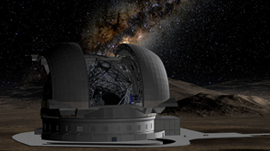
The atmospheric turbulence that distorts the trajectory of lights rays have been a source of frustration for astronomers using huge telescopes.
Damien Gratadour, an associate professor at Université Paris Diderot, was at the GPU Technology Conference last month to talk about how his team is using NVIDIA GPUs to reshape light beams so astronomers can get images that are as sharp as possible out of large telescopes like the European Extremely Large Telescope (E-ELT) — currently under construction and due to become operational in 2024.
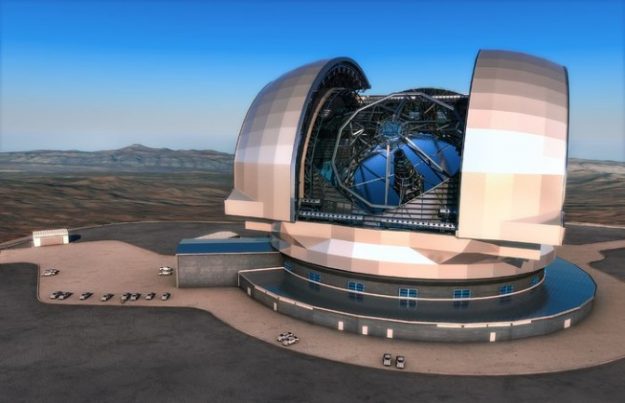
The $4.3 million effort, dubbed the Green Flash project, is focused on prototyping real-time controllers that would provide millions of commands each second to the giant telescope’s deformable mirror, which is expected to result in significant stabilization of the telescope’s image quality.
Gratadour said that GPUs are revolutionizing adaptive optics, which are used to compensate for the fast-evolving aberrations that occur in optical systems, by enabling them to process large-scale images in real time from wavefront sensors that measure those aberrations.