NVIDIA CUDA Python
NVIDIA® CUDA® Python is a set of tools and libraries that enable Python developers to leverage NVIDIA’s CUDA platform for GPU-accelerated computing. It allows Python applications to utilize the parallel processing power of NVIDIA GPUs, significantly speeding up computationally intensive tasks.
CUDA Python bridges the gap between the productivity of Python and the computational power of NVIDIA GPUs, making GPU acceleration more accessible to a wider range of Python developers in fields like data science, machine learning, and scientific computing.
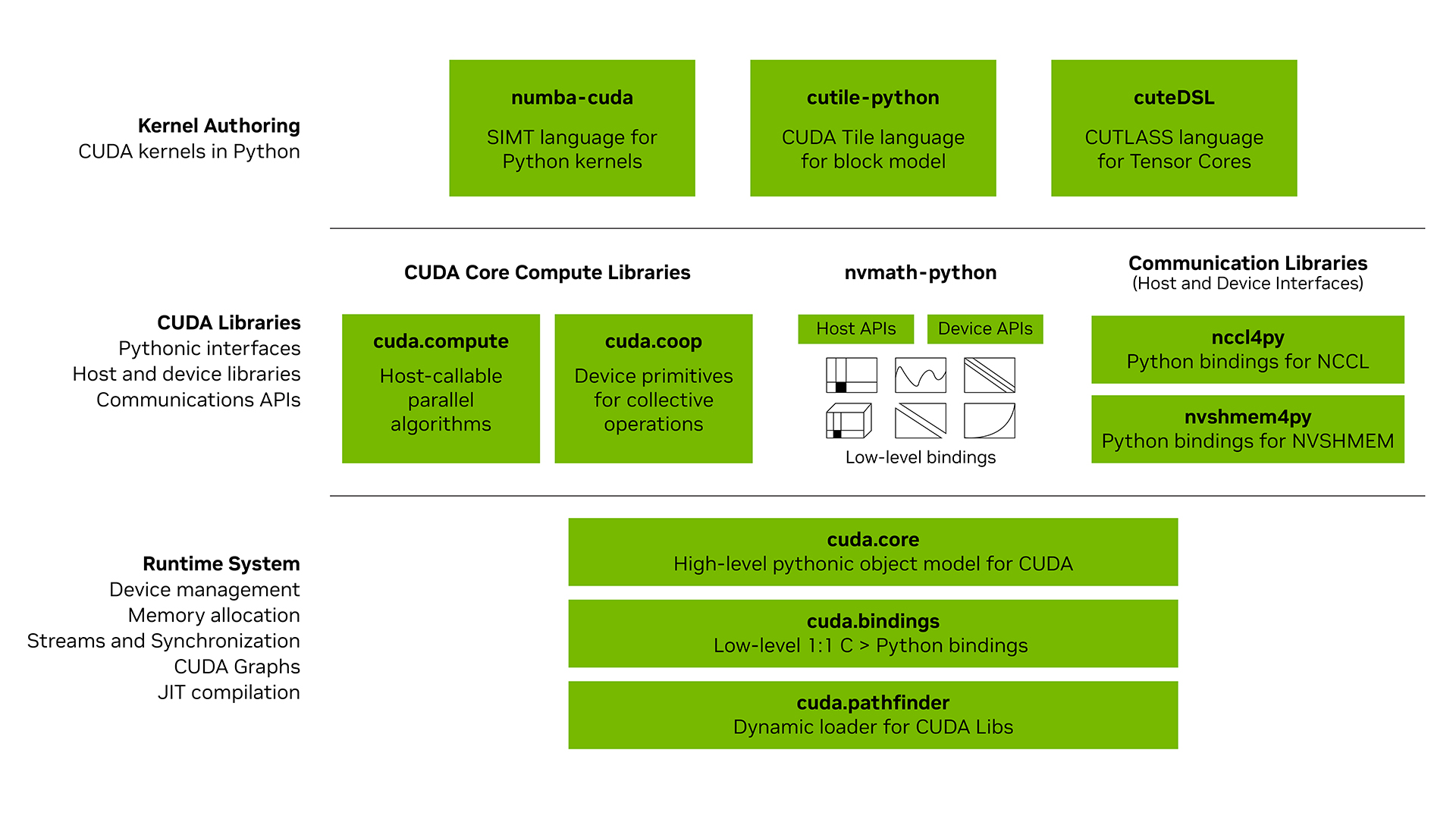
How CUDA Python Works
CUDA Python provides uniform APIs and bindings for inclusion into existing toolkits and libraries to simplify GPU-based parallel processing for HPC, data science, and AI.
CUDA Python enables seamless access to NVIDIA’s CUDA platform from Python. It consists of multiple components:
cuda.core: Pythonic access to CUDA runtime and other core functionalities
cuda.bindings: Low-level Python bindings to CUDA C/C++ APIs
cuda.pathfinder: Utilities for locating CUDA components installed in the user’s Python environment
cuda.cccl.coop: A Python module providing CCCL’s reusable block-wide and warp-wide device primitives for use within Numba CUDA kernels
cuda.cccl.compute: A Python module for easy access to CCCL’s highly efficient and customizable parallel algorithms, like sort, scan, reduce, transform, etc., that are callable on the host
numba.cuda: Numba’s target for CUDA GPU programming by directly compiling a restricted subset of Python code into CUDA kernels and device functions following the CUDA execution model
nvmath-python: Pythonic access to NVIDIA CPU and GPU math libraries, with both host and device (through nvmath.device) APIs, and also provides low-level Python bindings to host C APIs (through nvmath.bindings)
As of CUDA 13.3, CUDA Python and C++ now stand as equal first-class citizens, with NVIDIA aiming to maintain feature-complete parity going forward. Please refer to the cuda.bindings documentation for installation guide and further detail.
Get Started With CUDA Python
Dive into high-performance computing by setting up your environment, writing your first CUDA Python code, and exploring the powerful features that harness the full potential of NVIDIA GPUs.

1,001 Ways to Write CUDA Kernels in Python
Explore best practices for writing CUDA kernels using Python, empowering developers to harness the full potential of GPU acceleration.

The CUDA Python Developer’s Toolbox
See practical examples of popular CUDA Python libraries in action, illustrating their effectiveness in real-world scenarios.

CUDA Python GitHub Repository
Explore the official CUDA Python GitHub repository, a comprehensive resource for developers leveraging NVIDIA GPUs in their Python code. This repository provides the latest Numba releases, detailed documentation, and a variety of examples to help you get started with GPU-accelerated computing and optimize your applications for high performance.
Starter Kits
Get up and running with NVIDIA CUDA Python GPU programming quickly and efficiently. Our starter kits are designed to provide everything you need to begin harnessing the power of NVIDIA GPUs in your Python applications.
GPU Programming
Designed by Python developers, for Python developers, this kit provides all the essential tools and resources to get you started quickly. Whether you're new to GPU programming or looking to enhance your existing Python applications, this is your go-to resource for harnessing the power of NVIDIA GPUs.
NVIDIA Math Libraries With CUDA Kernel Fusion in Python
This kit is designed to help developers understand and implement kernel fusion, a technique that combines multiple GPU kernels into a single, more efficient kernel to reduce memory transfers and improve performance.
Streamline Python Workflows With Wheel Variants
This starter kit simplifies the installation and packaging of CUDA-accelerated Python applications by providing tools and guidelines to create and distribute wheel variants compatible with multiple CUDA versions and environments.
Domain Libraries
This kit explores NVIDIA’s GPU-accelerated domain libraries—RAPIDS™, CUDA-Q™, Warp, and PyTorch—giving developers the resources to quickly integrate specialized, high-performance capabilities into their Python applications.
Ecosystem
Our goal is to help unify the Python CUDA ecosystem with a single standard set of interfaces, providing full coverage of, and access to, the CUDA host APIs from Python. We want to provide a shared foundation that empowers the ecosystem to build cohesively, ensuring different accelerated libraries work together to solve complex computational challenges. We also want to lower the barrier to entry for Python developers.
Software Partners
CuPy is a NumPy/SciPy-compatible array library from Preferred Networks for GPU-accelerated computing with Python. CUDA Python simplifies the CuPy build and allows for a faster and smaller memory footprint when importing the CuPy Python module. In the future, when more CUDA Toolkit libraries are supported, CuPy will have a lighter maintenance overhead and have fewer wheels to release. Users will benefit from a faster CUDA runtime.
Numba, a Python compiler from Anaconda that can compile Python code for execution on CUDA-capable GPUs, provides Python developers with an easy entry into GPU-accelerated computing and a path for using increasingly sophisticated CUDA code with a minimum of new syntax and jargon. With CUDA Python and Numba, you get the best of both worlds: rapid iterative development with Python and the speed of a compiled language targeting both CPUs and NVIDIA GPUs.
More Resources




pip install cuda-python