NVIDIA CUDA-Q
CUDA-Q™ is NVIDIA’s open platform for quantum computing and the foundation for accelerated quantum supercomputing.
pip install cudaq
How CUDA-Q Works
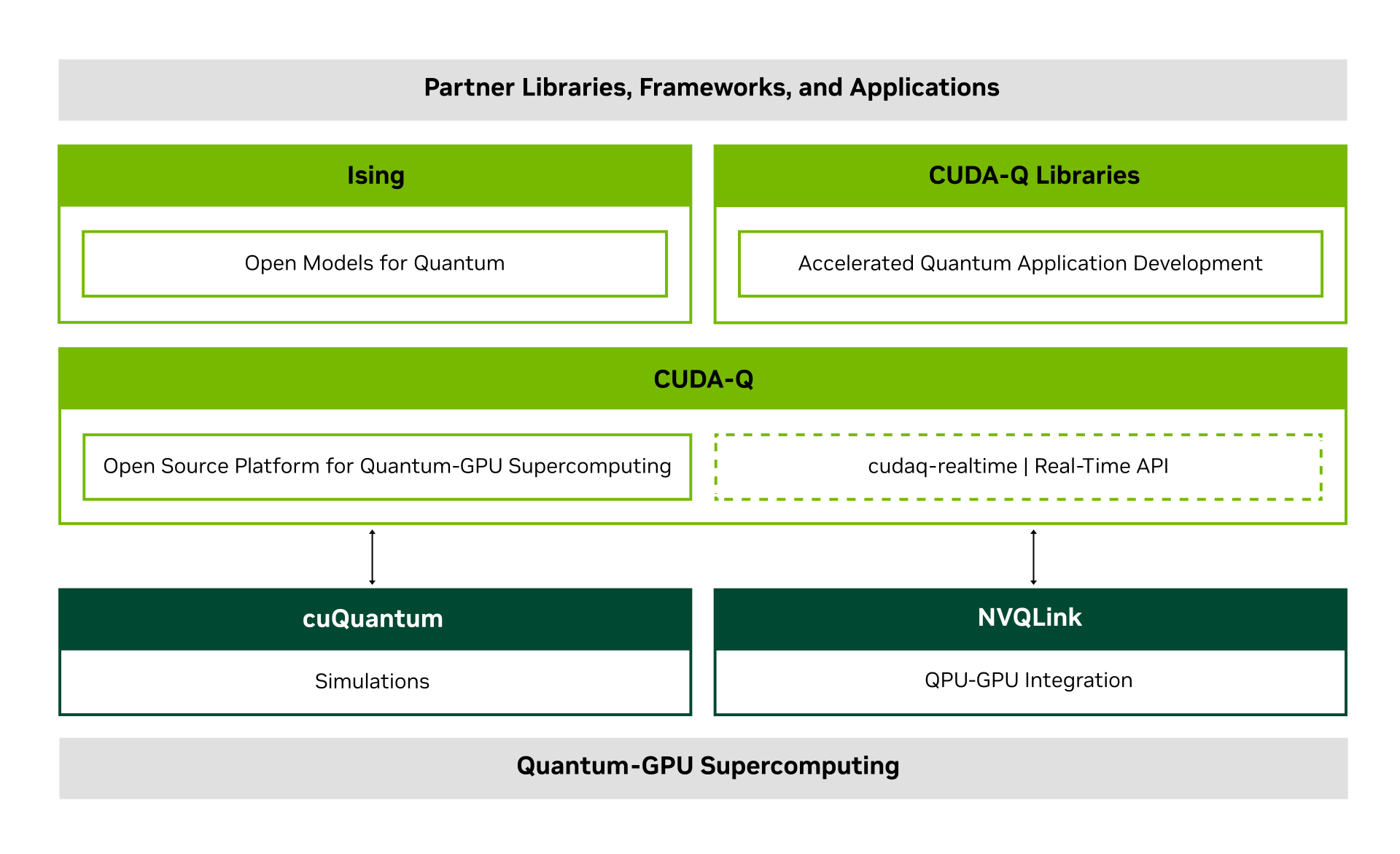
CUDA-Q is an open-source quantum development platform for running powerful, large-scale quantum computing applications. It uses a kernel-based programming model that extends the proven power of NVIDIA® CUDA® to quantum accelerators, enabling computation across GPU, CPU, and QPU resources within a single program. CUDA-Q integrates with any QPU or qubit modality and supports both GPU-QPU integration and GPU-accelerated simulation.
Built for the Future of Quantum Computing
CUDA-Q is designed for researchers and engineers building at the frontier of quantum computing, with a full suite of libraries and developer tools covering quantum error correction, algorithm development, and more. The platform supports industry-leading simulators and real quantum processors from a growing ecosystem of hardware vendors. Both can leverage AI supercomputing to accelerate GPU simulations or control and enhance QPU operations, charting a clear path from today’s NISQ devices to large-scale, error-corrected quantum-GPU supercomputing.
Part of an Ecosystem
CUDA-Q is a modular quantum computing platform. It includes Python and C++ programming models, high-performance compilers, libraries for quantum error correction and algorithm development, accelerated decoders, QPU and simulator backends, open AI models, and a broad set of tools and datasets. Behind it all is the world’s largest ecosystem of hardware, software, control, and applications partners building on the platform.
Key Features

Write Once, Run Everywhere
CUDA-Q is QPU agnostic and integrates with 75% of publicly available QPUs. Write your code once and run on all qubit modalities.

Use Familiar Tools
Use Python or C++ to describe your algorithm in a high-level language. The CUDA-Q compiler will lower and optimize the code based on the backend, using industry tools such as Multi-Level Intermediate Representation (MLIR), Low Level Virtual Machine (LLVM), and Quantum Intermediate Representation (QIR).

Be Part of the Community
CUDA-Q is an open-source project and is part of the quantum community. It interops with AI and high-performance computing (HPC) libraries and visualization tools.
Starter Kits
Quick-Start to Quantum-GPU Supercomputing
New to quantum? Learn the basics and program your first quantum-GPU application.
Quantum Error Correction
Learn how to do quantum error correction with CUDA-Q.
Dynamic Simulation
Learn about the dynamics capabilities in CUDA-Q.
Optimization
Use AI to build quantum circuits to solve the max-cut problem with a generative pretrained transformer for the Quantum Approximate Optimization Algorithm (QAOA-GPT).
Use Cases
Fault-Tolerant Qubits
Infleqtion demonstrated error-corrected, logical qubits using neutral atoms.
AI for Algorithm Design
The University of Toronto developed the Generative Quantum Eigensolver—a new class of quantum algorithms that uses AI to improve performance.
Solar Energy Prediction
The Chung Yuan Christian University developed a quantum neural network model for solar irradiance forecasting, showing faster training and improved performance.
Divisive Clustering
The University of Edinburgh developed a method of finding data patterns and clustering big data so it can be used in quantum computers.
Molecular Generation
Yale University developed a hybrid transformer with a quantized self-attention mechanism applied to molecular generation.
Circuit Synthesis
The University of Innsbruck used diffusion models to synthesize arbitrary unitaries into CUDA-Q kernels.
CUDA-Q Learning Library
Latest CUDA-Q News
CUDA-Q Ecosystem
CUDA-Q is accelerating work across the quantum computing ecosystem, including partner integrations that range from building and controlling better quantum hardware to developing the first useful quantum algorithms.