NVIDIA Kumo
NVIDIA Kumo is a family of open models, libraries, and tools for making predictions from tabular, relational, and time-series data. Developers can use Kumo to forecast outcomes, score risk, detect anomalies, and generate recommendations—without building and maintaining a separate machine learning model for every task.
As part of the NVIDIA Agent Knowledge Foundation—open models and libraries for grounding agents in enterprise data—NVIDIA Kumo handles predictions such as forecasting outcomes, scoring risk, detecting anomalies, and recommending actions. Traditional predictive machine learning requires teams to prepare data, engineer features, train and tune a model, and build a deployment pipeline for each task. Kumo moves much of this repeated work into reusable foundation models purpose-built for structured data.
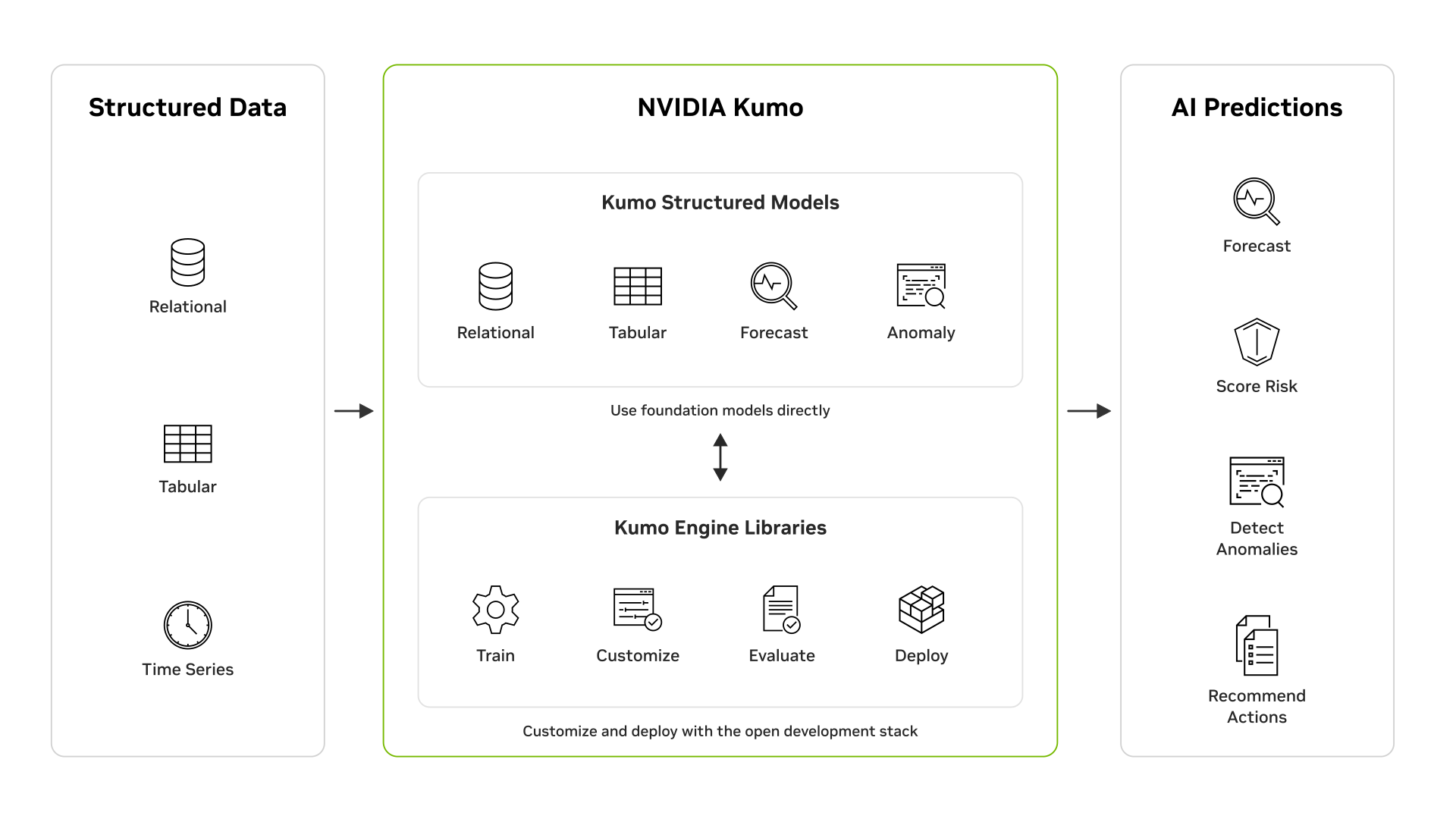
NVIDIA Kumo Models
Kumo Structured is a collection of open models for prediction across connected tables, single-table data, and time-series signals. Use these models out of the box, adapt them to your data, or train custom models for specialized workloads.
Run Kumo Relational and Tabular with Kumo Structured Data Models, a GPU-native toolkit that combines model execution and data processing through a unified, PyTorch-compatible interface. Run Kumo Forecast and Anomaly with Kumo-TS, which provides Python APIs, installation instructions, and examples for forecasting future values and detecting unusual patterns.
NVIDIA Kumo Relational
Make predictions across connected tables with a pretrained model that uses relationships between enterprise records.
- Support classification and regression across related tables.
- Use labeled examples as context through in-context learning.
Combine row embeddings with relational message passing.
NVIDIA Kumo Tabular
Predict outcomes from a single table using labeled examples, without task-specific model training.
- Support classification and regression through in-context learning.
- Return class probabilities or numeric predictions with uncertainty estimates.
Choose small, medium, or large models for your workload.
NVIDIA Kumo Forecast
Explore time-series forecasting for demand planning, capacity management, and other time-dependent workloads.
Generate forecasts from historical numeric signals.
Combine model forecasts with retrieved historical patterns through DARR.
Support short- and long-horizon forecasting.
NVIDIA Kumo Anomaly
Explore unusual behavior in time-series data to investigate operational, manufacturing, and infrastructure issues.
- Use diffusion-based modeling for time-series imputation and anomaly detection.
- Apply adaptive thresholds to signals that change over time.
- Return anomaly labels alongside timestamps and observed values.
Get Started With Kumo Engine
Kumo provides open libraries and tools to support model building, training, customization, evaluation, and deployment. Build, train, and evaluate custom relational prediction models on your data. Before installing, follow the documentation to prepare your Python environment, local storage, and data access. Then choose the pip command for your integration and follow the corresponding setup guide below.
Introductory Resources
NVIDIA Kumo Tabular Sets a New Accuracy-Efficiency Frontier for Tabular Prediction
Most tabular models need task-specific training; Kumo Tabular doesn’t—it uses labeled rows as context to predict new outcomes. Explore the architecture, benchmarks, and a Python example.
Predict Across Connected Tables With NVIDIA Kumo Relational
Learn how Kumo Relational predicts outcomes directly from enterprise databases without task-specific training, feature engineering, or flattening tables.
Detect Time-Series Anomalies With NVIDIA Kumo Anomaly
Explore how diffusion modeling and adaptive thresholding identify unusual behavior in noisy, multivariate time-series data.
Forecast What’s Next With NVIDIA Kumo Forecast
Explore how Kumo Forecast uses pretrained time-series representations, optional historical pattern retrieval, and interpretability tools to predict future values and explain its forecasts.
Starter Kits
Explore practical workflows for customer churn prediction, fraud detection, and demand forecasting. Choose a starter kit based on your data structure and prediction task.
Predict Customer Churn
Use Kumo Relational to predict churn from connected customer, account, and activity data, helping prioritize retention outreach.
Models: Kumo Relational
Code Example: Predict Customer Churn
Build Fraud Detection Models With Kumo Engine
Build and evaluate a fraud detection model using connected account and transaction data, with money-laundering detection as a practical example.
Get Started: Kumo Engine
Code Example: Detect Money Laundering
Forecast Demand and Operations
Use Kumo Forecast to predict future demand and operational workloads from historical time-series signals and retrieved patterns.
Models: Kumo Forecast
Guide: Forecast Quick Start
Code Example: Fine-Tune Example
More Resources


Ethical Considerations
NVIDIA believes Trustworthy AI is a shared responsibility, and we have established policies and practices to enable development for a wide array of AI applications. When downloading or using this model in accordance with our terms of service, developers should work with their internal model team to ensure this model meets requirements for the relevant industry and use case and addresses unforeseen product misuse.
Please report security vulnerabilities or NVIDIA AI concerns here.