Understanding Simulation and Validation
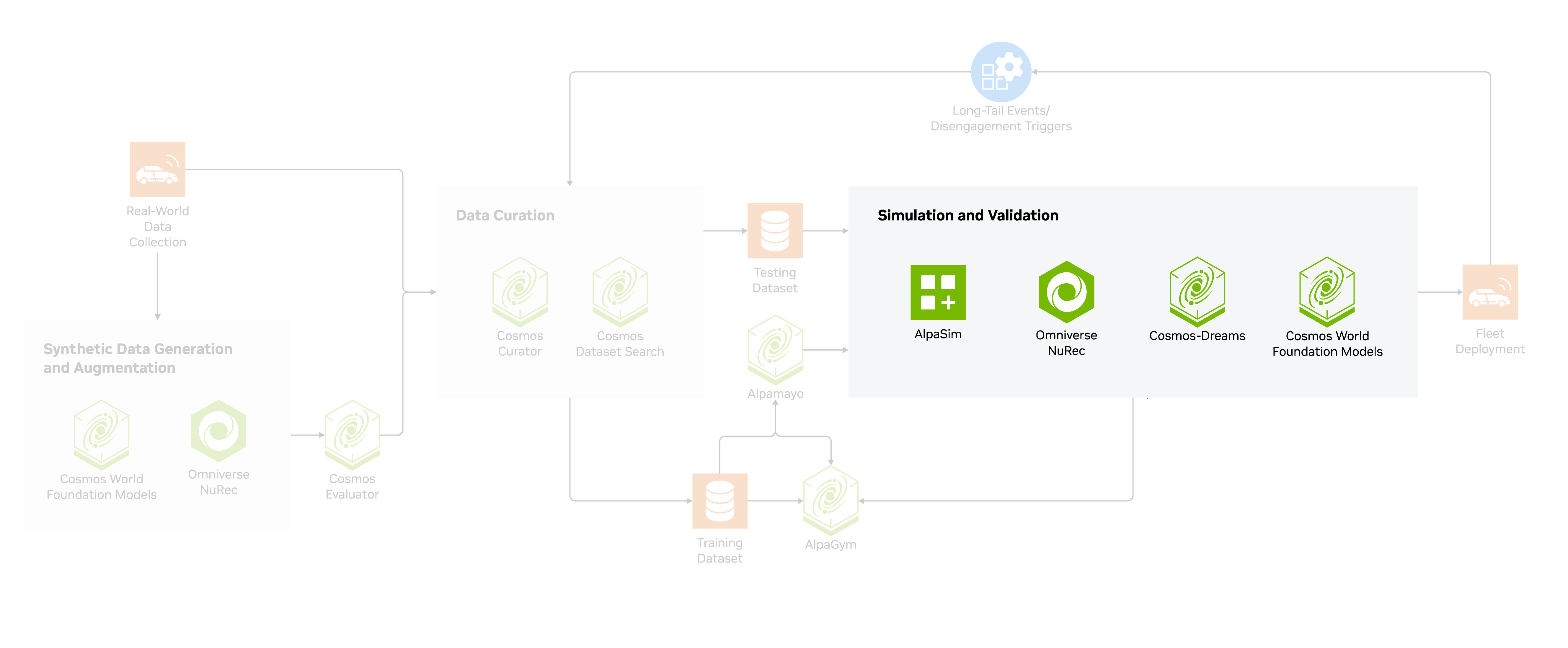
Simulation for autonomous vehicles starts from reconstructed real-world scenes and synthetic data. Real-world, multi-sensor driving data becomes high-fidelity 3D environments through neural reconstruction with NVIDIA Omniverse™ NuRec, while NVIDIA Cosmos™ world foundation models and NVIDIA Cosmos-Dreams generate novel scenario variations across weather, lighting, and long-tail edge cases.
Driving stacks are then validated in closed-loop using NVIDIA AlpaSim, an open source simulation framework that surfaces policy behavior across millions of virtual scenarios.
Explore Simulation Technologies
AlpaSim
NVIDIA AlpaSim is an open simulation framework that combines Omniverse NuRec scenes, configurable traffic and policy models, and scalable closed‑loop testing to iterate AV stacks over millions of virtual miles.
Omniverse NuRec
NVIDIA Omniverse Nurec is a set of Gaussian-based libraries that reconstruct and render interactive simulation from real-world driving data, accelerating high-fidelity simulation at scale.
Cosmos 3
NVIDIA Cosmos 3 is the frontier open world foundation model for physical AI and the first full omnimodel to understand and generate text, image, video, ambient sound, and action. It unifies vision reasoning, world and action generation to accelerate vision analytics, synthetic data, simulation, and policy improvement. Generate custom, diverse, and high-fidelity sensor data to safely train, test, and validate autonomous vehicles.
Cosmos 3 Simulation Models for Multisensor Generation
Expand training and testing for autonomous driving through synchronized multi camera and lidar generation. Planned multimodal generation responds to driving actions and configurable sensor layouts, targeting up to 11 camera views, including fisheye, for closed-loop testing and synthetic data generation.
Harmonizer NIM
NVIDIA Harmonizer is a diffusion model that corrects artifacts, lighting mismatches, and temporal flicker in neural scene renderings, improving visual consistency for training and simulation.
Simulation and Validation Learning Resources
Other DRIVE Resources
Model Development
Build and train reasoning-based AV models with open datasets, tools, and frameworks.
DRIVE AGX
Get developer kits and SDKs for in-vehicle compute development.
Download Center
Download DRIVE SDKs, open models, and simulation tools.
Support
Ask questions and get answers in our developer forum.