Autonomous Vehicle Simulation and Validation

NVIDIA simulation technologies accelerate autonomous vehicle development with high-fidelity simulation and synthetic data generation pipelines.

Understanding Simulation and Validation

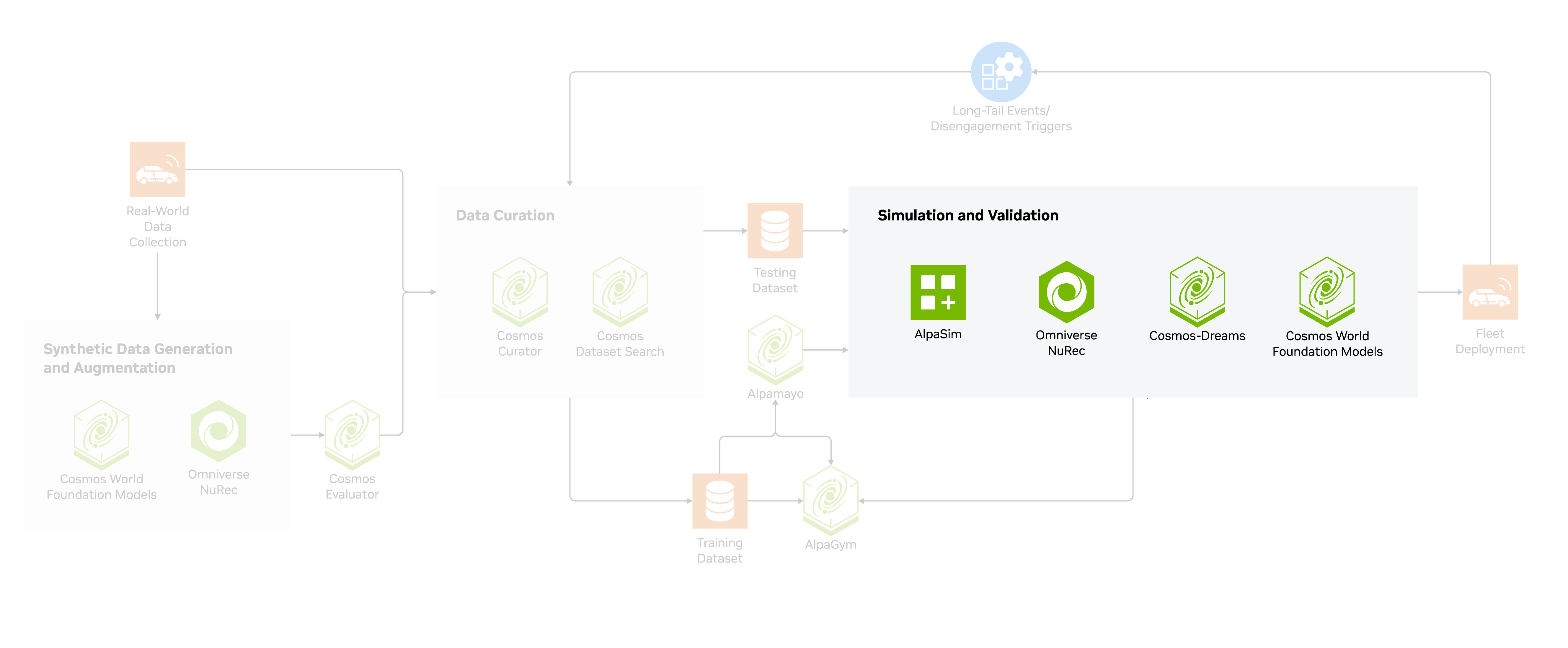
Simulation for autonomous vehicles starts from reconstructed real-world scenes and synthetic data. Real-world multi-sensor driving data becomes high-fidelity 3D environments through neural reconstruction with NVIDIA Omniverse™ NuRec, while NVIDIA Cosmos™ world foundation models and NVIDIA OmniDreams generate photorealistic variations and scenario videos that expand coverage far beyond what physical data collection can provide.

Driving stacks are validated in closed-loop using NVIDIA AlpaSim, an open-source simulation framework that runs models across millions of virtual miles where decisions shape how each scenario unfolds. Closed-loop reinforcement learning with NVIDIA AlpaGym improves model performance iteratively across those scenarios before real-world deployment.

Virtual environment simulation

Explore Simulation Technologies

Omniverse NuRec

NVIDIA Omniverse Nurec
reconstructs high‑fidelity 3D worlds from real‑world multi‑sensor driving data. It then renders new sensor views and trajectories for replay, validation, and synthetic data generation.

Alpamayo 2 Super

NVIDIA Alpamayo 2 Super is an open 32-billion-parameter reasoning VLA model that reasons, plans and acts across the full driving stack for safer, scalable level 4 development.

Alpamayo 1.5 is available now. Alpamayo 2 Super is coming soon.

AlpaSim

NVIDIA AlpaSim is an open source AV simulation framework that combines Omniverse NuRec scenes, configurable traffic and policy models, and scalable closed‑loop testing to iterate AV stacks over millions of virtual miles.

AlpaGym

NVIDIA AlpaGym is a closed-loop reinforcement learning framework that improves autonomous driving policy development by training against the compounding errors that open-loop, log-replay training leaves uncorrected.

Coming Soon.

NVIDIA OmniDreams

NVIDIA OmniDreams is a generative world model built on NVIDIA Cosmos that synthesizes photorealistic closed-loop driving environments from real-world driving data or simulation inputs.

Cosmos Transfer 2.5

NVIDIA Cosmos Transfer 2.5 uses world foundation models to generate faster, better photorealistic world variations from text prompts and spatial controls. This expands real‑world driving data into rich scenario families.

Cosmos 3 for AV is coming soon.

Cosmos Predict 2

NVIDIA Cosmos Predict 2 can be post‑trained on AV data to generate single and multiview videos for simulation. This accelerates scenario creation and coverage for downstream training and testing.

Cosmos 3 for AV is coming soon.

Cosmos Evaluator

The NVIDIA Cosmos Evaluator automated scoring system validates synthetic video quality across hallucinations, object correspondence, environment conditions, and attributes at scale.

Autonomous Vehicle Learning Resources

Accelerate AV Simulation With Neural Reconstruction and World Models

In this tech blog, we highlight the latest NVIDIA APIs, Cosmos world foundation models, and NVIDIA NIM™ microservices to help you kickstart your data pipelines.

Simplify End-to-End AV Development With New NVIDIA Cosmos Transfer NIM

This blog showcases how you can create world models and generate synthetic data (SDG) to accelerate end-to-end AV training, as well as closed-loop training and in-vehicle inference.

Simulate and Scale Real-World AV Data With NuRec and Cosmos on CARLA

Deep dive into the latest open-source CARLA 0.9.16 release, and learn how to use AV simulation pipelines with NuRec and Cosmos Transfer. This session covers neural reconstruction and rendering workflows to bring real-world sensor data into simulation.

Enhance 3D Gaussian Reconstruction Quality for AV Simulation Using NuRec Fixer

Learn how to use NuRec Fixer to transform noisy 3D scenes into a crisp, artifact-free environment ready for AV simulation.